Comprehensive Guide to BIS Scheme X Certification: Ensuring Safety and Compliance in Machinery and Electrical Equipment
September 04, 2025
Introduction
In today's rapidly evolving industrial landscape, ensuring the safety and quality of machinery and electrical equipment is paramount. The Bureau of Indian Standards (BIS) introduced Scheme X under the Conformity Assessment Regulations to address this need. This certification scheme mandates compliance with stringent safety standards, fostering consumer trust and facilitating market access for manufacturers.
What is BIS Scheme X Certification?
BIS Scheme X Certification is a mandatory conformity assessment scheme introduced by the Bureau of Indian Standards. It applies to low-voltage switchgear, control gear, Implemented on March 16, 2022, Scheme X aims to align Indian manufacturing practices with global safety benchmarks.
Understanding the Omnibus Technical Regulation (OTR)
The Omnibus Technical Regulation (OTR), also known as the Machinery and Electrical Equipment Safety Order, 2024, was issued by the Ministry of Heavy Industries on August 28, 2024. This regulation mandates that machinery and electrical equipment, including their assemblies and components, comply with BIS Scheme X standards. However, certain categories are exempted:
Exempted Categories:
Machinery and components covered under (other than omnibus technical regulation) orders made under Section 16 of the BIS Act, 2016.
Domestically produced goods intended solely for export.
Construction equipment regulated under the CMVR Rule 1989 by the Ministry of Road Transport and Highways.
Benefits of BIS Scheme X Certification
Market Access: Mandatory for selling specified products in the Indian market.
Enhanced Safety: Ensures products meet rigorous safety standards, reducing the risk of accidents.
Consumer Trust: The BIS mark signifies quality and compliance, boosting consumer confidence.
Legal Compliance: Avoids penalties associated with non-compliance under the BIS Act.
Competitive Advantage: Demonstrates commitment to quality, differentiating products in the marketplace.
Scheme X: Certification for Low Voltage Switchgear & Control Gear
Sr No.
Indian Standards
Title of Standard
Product category
Specific Requirement
1.1 (a)
IS/IEC 60947: Part 2:2016
Low-Voltage switchgear and control gear: Part 2 circuit- Breaker (First Revision)
AC Circuit – Breakers (Category A) – All ratings upto 630 A, upto 440V AC
All tests as per IS/IEC 60947: Part 2: 2016 except the test listed below in Sr. No. 1.1.(b) of this table
1.1 (b)
AC Circuit – Breakers (Category A) – All rating upto 630 A, upto 440V AC
Electromagnetic compatibility (EMC) mentioned in Anne J and All test specified for specific application as mentioned in the Annexure(s) of the IS/IEC 60947: Part 2: 2016
1.2.(a)
AC Circuit – Breakers (Category A) – All rating above 630 A, upto 440V AC
All test as per IS/IEC 60947: Part 2: 2016 except the test listed below in Sr. No. 1.2.(b) of this table
1.2.(b)
AC Circuit – Breakers (Category A) – All rating above 630 A, upto 440V AC
Electromagnetic compatibility (EMC) mentioned in Anne J and All test specified for specific application as mentioned in the Annexure(s) of the IS/IEC 60947 : Part 2: 2016
1.3.(a)
AC Circuit – Breakers (Category B)- All rating upto 2000 A, upto 440V AC
All test as per IS/IEC 60947: Part 2: 2016 except the test listed below in Sr. No. 1.3.(b) of this table
1.3.(b)
AC Circuit – Breakers (Category B)- All rating upto 2000 A, upto 440V AC
Electromagnetic compatibility (EMC) mentioned in Anne J and All test specified for specific application as mentioned in the Annexure(s) of the IS/IEC 60947 : Part 2: 2016
1.4
AC Circuit – Breakers (Category A) – All rating above 440V AC
All test as per IS/IEC 60947: Part 2: 2016
1.5
AC Circuit – Breakers (Category B)- rating above 2000 A, upto 440V AC
1.6
AC Circuit – Breakers (Category B)- All rating above 440V AC
1.7
DC Circuit – Breaker (Category A) – All rating
1.8
AC Circuit – Breaker (Category B)- All rating
2
IS/IEC 60947: Part 3:2012
Low-Voltage switchgear and control gear: Part 3 switches, disconnectors, switch disconnectors and fuse – Combination units
All types of product ratings
All test as per IS/IEC 60947: Part 3: 2012
3
IS/IEC 60947: Part 4: Sec 1: 2012
Low-Voltage switchgear and control gear: Part 4 contactors and motor – Starters: Sec 1 electromechanical contactors and motor – Starters (First Revision)
All test as per IS/IEC 60947: Part 4: Sec 1: 2012
4
IS/IEC 60947: Part 4: Sec 2: 2011
Low-Voltage switchgear and control gear: Part 4 contactors and motor – Starters: Sec 2 a.c. semiconductor motor controllers and starters (First Revision)
All test as per IS/IEC 60947: Part 4: Sec 2: 2011
5
IS/IEC 60947: Part 4: Sec 3: 2014
Low-Voltage switchgear and control gear: Part 4 contactors and motor – Starters: Sec 3 a.c. semiconductor motor controllers and contactors for non – Motor loads ( Second Revision)
All test as per IS/IEC 60947: Part 4: Sec 3: 2014
6
IS/IEC 60947: Part 5: Sec 1: 2009
Low-Voltage switchgear and control gear: Part 5 control circuit devices and switching elements: Sec 1 electromechanical control circuit devices ( First Revision)
All test as per IS/IEC 60947: Part 5: Sec 1: 2009
7
IS/IEC 60947: Part 5: Sec 2: 2007
Low-Voltage switchgear and control gear: Part 5 control circuit devices and switching elements: Sec 2 proximity switches
All test as per IS/IEC 60947: Part 5: Sec 2: 2007
8
IS/IEC 60947: Part 5: Sec 5: 2016
Low-Voltage switchgear and control gear: Part 5 control circuit devices and switching elements: Sec 5 electrical emergency stop devices with mechanical latching function
All test as per IS/IEC 60947: Part 5: Sec 5: 2016
Machinery And Electrical Equipment Covered Under Omnibus Technical Regulation
Sr No.
Description of Machinery and Electrical Equipment
HS Code
1
All types of Pumps for handling liquids, liquid elevators and (or) their assemblies /sub-assemblies/components
841340, 841350, 841360, 841370, 841381, 841382 841391 and 841392.
2
All types of compressors and (or) their assemblies /sub-assemblies/components
841430, 841440, 84148011, 84148090, 84149011,84149019, 84149040 and 84149090.
3
All types of machinery for treatment of material by a process involving a change of temperature and/or their assemblies /sub-assemblies/components
841932, 841939,841940, 841950, 841960,841981, 841989 and 84199090.
4
All types of centrifuges, filtering or purifying machinery for liquid and gas and/or their assemblies /sub-assemblies/components
All types of weaving machines (looms) and (or) their assemblies /sub-assemblies /components.
8446, 844811, 844819, 844842 and 844849.
9
All types of machinery for making embroidery and (or) their assemblies /sub-assemblies /components.
84479020 and 844859.
10
All types of metal cutting machines tools covered under the heading 8456 to 8461 and (or) their assemblies /sub-assemblies/components
8456, 8457, 8458, 8459, 8460, 8461 and 846693.
11
All types of machine tools for working stone, ceramics, concrete, asbestos cement or like mineral (or) and their assemblies /subassemblies /components.
8464 and 84669100.
12
All types of machinery for working rubber and plastics and (or) their assemblies /sub-assemblies /components
8477
13
All types of Machines including the machines for public works & building and the machinery & mechanical appliances having individual functions, not specified Or included elsewhere in Chapter 84 and(or) their assemblies/subassemblies /components
84791000, 84798999 and 84799090.
14
All types of gears and gearing, toothed wheels, chain sprocket, transmission elements ball or roller screws, gear boxes and speed changers, including torque converters And (or) their assemblies /sub-assemblies /components
84834000 and 84839000.
15
All types of Rotary electrical machines such as Generator, etc and (or) their assemblies /sub-assemblies /components.
8501 and 8503.
16
All types of Diesel Generator and (or) their assemblies /sub-assemblies /components.
8502 and 8503.
17
All types of Transformers and (or) their assemblies /sub-assemblies /components.
850421, 850422,850423, 850431, 850432,850433, 850434 and 850490.
18
All types of Power Semiconductor Converter and (or) their assemblies /sub-assemblies /components.
850440
19
All types of switch gear and control gear equipment operating at voltages not exceeding 1000 volts and (or) their assemblies /sub-assemblies /components.
8536, 8537 and 8538.
20
All types of switch gear and control gear equipment operating at voltages exceeding 1000 volts and (or) their assemblies /sub-assemblies /components.
8535, 8537 and 8538.
Scope and Applicability of BIS Scheme X Certification
The Quality Control Order under BIS Scheme X is applicable to a wide range of industrial machinery and electrical equipment, including their assemblies, sub-assemblies, and components. Below is a detailed classification of product categories covered under this scheme:
Pumps and Liquid Handling Equipment This includes all types of pumps used for handling liquids, such as liquid elevators and their respective assemblies and components.
Compressors Encompasses all variants of compressors along with their integral assemblies, sub-assemblies, and parts.
Thermal Treatment Machinery Covers equipment used for thermal processing or material treatment involving changes in temperature, along with associated components.
Centrifuges and Filtering Systems Includes centrifuges, as well as filtering or purifying machinery used for liquids and gases, with all related assemblies and parts.
Packaging Machinery Involves machines for filling, sealing, closing, labeling, packing, and wrapping, including their sub-assemblies and integral mechanisms.
Cranes All crane types, from overhead to mobile, and their respective structural and functional assemblies and components fall under this category.
Construction, Earthmoving, and Mining Equipment Encompasses machinery used in construction, excavation, and mining operations, inclusive of all associated sub-systems.
Textile Machinery Covers machines like weaving looms and embroidery systems, as well as their supporting assemblies and control units.
Metalworking and Mineral-Based Machinery Applies to metal-cutting machines and those used for working on stone, ceramics, concrete, asbestos cement, or similar materials.
Rubber and Plastic Processing Equipment Includes machinery specifically designed for handling rubber and plastics, along with all integrated components.
General-Purpose Machinery and Mechanical Appliances Covers machinery designed for specific functions not covered elsewhere under Chapter 84 of the HSN code, including all modular parts.
Transmission Components This includes gears, gearboxes, toothed wheels, ball and roller screws, torque converters, and similar power transmission mechanisms.
Rotary Electrical Machines Encompasses generators and other rotary electrical devices, including their control systems and auxiliary units.
Diesel Generators Covers diesel-powered generator units and their associated mechanical and electrical subsystems.
Transformers All categories of transformers used for voltage regulation and their integral assemblies are included here.
Power Semiconductor Converters Applies to devices that convert electrical power using semiconductors, along with their controller boards and interfaces.
Switchgear and Control Gear Includes all types of switchgear and control gear equipment designed to operate at various voltages for industrial and commercial applications.
Certification Process
Application Submission: Manufacturers submit the application along with required documents to BIS.
Product Testing: Samples are tested in BIS-recognized laboratories to ensure compliance with relevant IS standards.
Factory Inspection: BIS officials conduct an inspection of the manufacturing facility to assess quality control measures.
Grant of License: Upon successful evaluation, BIS grants the license, allowing the use of the BIS Standard Mark.
Surveillance: Periodic surveillance audits and product testing ensure continued compliance.
Documents Required
Application form.
Business license and manufacturing registration.
Product specifications and technical documents.
Test reports from BIS-recognized laboratories.
Quality control manuals and procedures.
Factory layout and process flow diagrams.
Validity and Renewal Process of BIS Scheme X Certification
License Duration and Renewal: Licenses for ongoing production are granted for a period ranging from 3 to 6 years, and can be renewed for an equivalent duration.
Certificate of Conformity: This certificate is granted for single-use production and applies to both domestic and international manufacturers. It is not eligible for renewal.
Production Test Reports: When test reports originate from the manufacturer's internal laboratory, BIS officials will validate the results through witness testing during the factory inspection. If testing is carried out at subcontracted in-house facilities, those locations will also undergo inspection.
Quality Control Orders & Penalties
Non-compliance with BIS Scheme X can lead to:
Monetary penalties.
Product recalls.
Legal action under the BIS Act, 2016.
Loss of market access and reputation.
Deadline to Act
You have until September 1 2026, to comply with this regulation. The earlier you begin the certification process, the better, to ensure your products remain market-ready without disruption.
Conclusion
Scheme X, introduced under the BIS Conformity Assessment Regulations, establishes a strong foundation for product quality and safety in India. By defining a clear and structured certification process, Scheme X enables manufacturers to meet the rigorous standards of Indian Standards while offering flexibility in production methods.
For consumers, Scheme X ensures confidence in the safety and quality of products, fostering trust in certified brands and enhancing the market’s overall reliability.
Why Choose Star Group for BIS Scheme X Certification?
Navigating the BIS certification landscape can be complex. Star Group offers expert guidance and end-to-end support to streamline the certification process. Our services include:
Comprehensive consultation on BIS requirements.
Assistance with documentation and application submission.
Coordination with BIS-recognized laboratories for product testing.
Preparation for factory inspections.
Ongoing support for compliance and renewal processes.
Partner with Star Group to ensure your products meet the highest safety standards and gain seamless access to the Indian market.
Frequently Asked Questions
A1: It is mandatory for products specified under the Omnibus Technical Regulation. Manufacturers should consult the latest BIS notifications to determine applicability.
A2: Yes, foreign manufacturers can apply through the Foreign Manufacturers Certification Scheme (FMCS) by appointing an Authorized Indian Representative (AIR).
A3: Scheme I covers a broad range of products, including consumer goods, and requires the ISI mark. Scheme X specifically targets machinery and electrical equipment, emphasizing safety compliance under the Omnibus Technical Regulation.
A4: The duration varies based on product complexity and documentation completeness
A5: BIS may suspend or cancel the certification, and the manufacturer may face penalties, including fines and product recalls.
Have any doubts? Please fill the form below to get in touch with us.
In this article, we are going to have a look at all the necessary documents required for the import and export procedure to be completed successfully.These import and export documents are essential to be kept in mind while importing or exporting goods.Let...
The Export clearance procedure is an important step while exporting goods from India.Customs Clearance is the process of authorization of a person or goods by the Customs Department.The authorization takes place after providing the proper customs clearanc...
In this article, we are going to discuss in detail the procedure of Import and Export in India.The Foreign Trade (Development and Regulation) Act, 1992, of India regulates the import and export of goods. It also facilitates the government to make necessar...
Advance Ruling is Trade Facilitation as per WTO agreementImporters and Exporters who have ambiguity about their goods Classification, Duty structure and Valuation method can go for Advance Ruling. Advance Ruling will ensure tariff classification, exemptio...
Duty Free Import Authorization Scheme (DFIA) ObjectiveThis scheme providing duty free inputs on post exports basis as a replenishment so that export product becomes competitive in the international market.DFIA is freely transferable. Eligibility Criteria...
Self-Sealing Permission Purpose Central Board of Indirect Taxes and Custom (CBIC ) has approved the program to promote exports Self Sealing Permission earlier was called as Factory Stuffing Permission; this permits containerize cargo to seal at their fact...
RESTRICTED LICENSEAs per the provisions of Exim Policies, The Central Government, in public interest, regulates the import or export of goods by means of a Negative List. This Negative Lists consist of goods for Export & import which are prohibited or res...
Brand Rate Fixation (Custom Act Section 75) When the manufacturer import the Raw material, Components & packing material after paying the Basic Custom Duty (BCD) & Social Welfare Surcharge (SWS) and utilizing the same for the manufacturing of export produ...
Preferential Trade Agreements A key benefit under PTA is preferential tariff, i.e. applicability of lower customs duty on import of goods from partner countries. India has notified separate rules for determining whether goods being imported from a country...
Status Holder Certificate All exporters of goods & services having an import-export code (IEC) number shall be eligible for recognition as a status holder on achieving specific turnover. Status recognition depends upon export performance An applicant shal...
Re- Import of Goods without payment of Duty Re-importing goods without payment of duty is allowed under various Customs notifications. Goods that were earlier exported can be brought back into the country without payment of import duties and taxes.Common...
Import of Goods for display in Trade Fairs and events without payment of Customs Duty Conditions: The importer must submit a Specific declaration, Re- export bond with bank guarantee 10% of duty amount. Imports by government entities, diplomatic missions,...
The Union Budget 2025-26 has unveiled transformative measures to bolster India's Micro, Small, and Medium Enterprises (MSMEs), recognizing their pivotal role in economic growth and employment generation.Enhanced MSME Classification CriteriaTo facilitate s...
IntroductionTo make international trade easier and more efficient for Indian businesses, the government has introduced a new digital platform called Bharat Trade Net (BTN). Announced during the Union Budget 2025, BTN aims to streamline trade processes, ma...
The Union Budget 2025-26 has introduced significant changes in customs duties related to the leather industry, benefiting both importers and exporters. Import of Wet Blue leather is now fully exempt from Basic Customs Duty (BCD).Export of Crust leather is...
The Union Budget 2025 has introduced a significant push for domestic manufacturing and value addition, particularly in the lithium-ion battery sector. With a growing emphasis on electric mobility and self-reliance, Finance Minister Nirmala Sitharaman anno...
The Indian government has taken a significant step towards strengthening the clean energy and electric vehicle (EV) sectors. In Budget 2025, Finance Minister Nirmala Sitharaman announced the exemption of customs duty on cobalt powder & waste, scrap of lit...
IntroductionIn today's rapidly evolving industrial landscape, ensuring the safety and quality of machinery and electrical equipment is paramount. The Bureau of Indian Standards (BIS) introduced Scheme X under the Conformity Assessment Regulations to addre...
The Ministry of Food Processing Industries (MoFPI), Government of India has issued a Notice Inviting Proposals for financial assistance to set up multi-product food irradiation units under the component scheme “Integrated Cold Chain and Value Addition Inf...
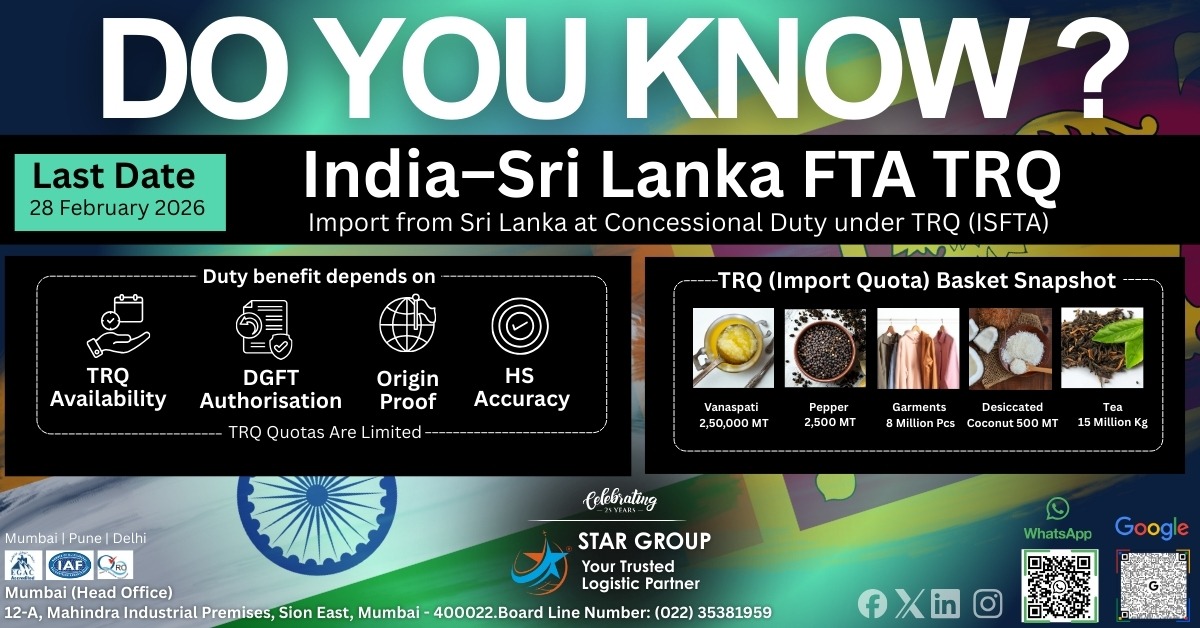
Under the India–Sri Lanka Free Trade Agreement (ISFTA), certain Sri Lanka–origin goods can be imported into India under a Tariff Rate Quota (TRQ) at concessional or Nil Customs duty. Once the notified annual quota is exhausted, imports attract normal tari...
Under the India–Mauritius CECPA, select products can be imported into India under a Tariff Rate Quota (TRQ). TRQ allows importers to claim a preferential in-quota duty rate for a notified quantity, subject to DGFT procedure and Customs compliance. What i...
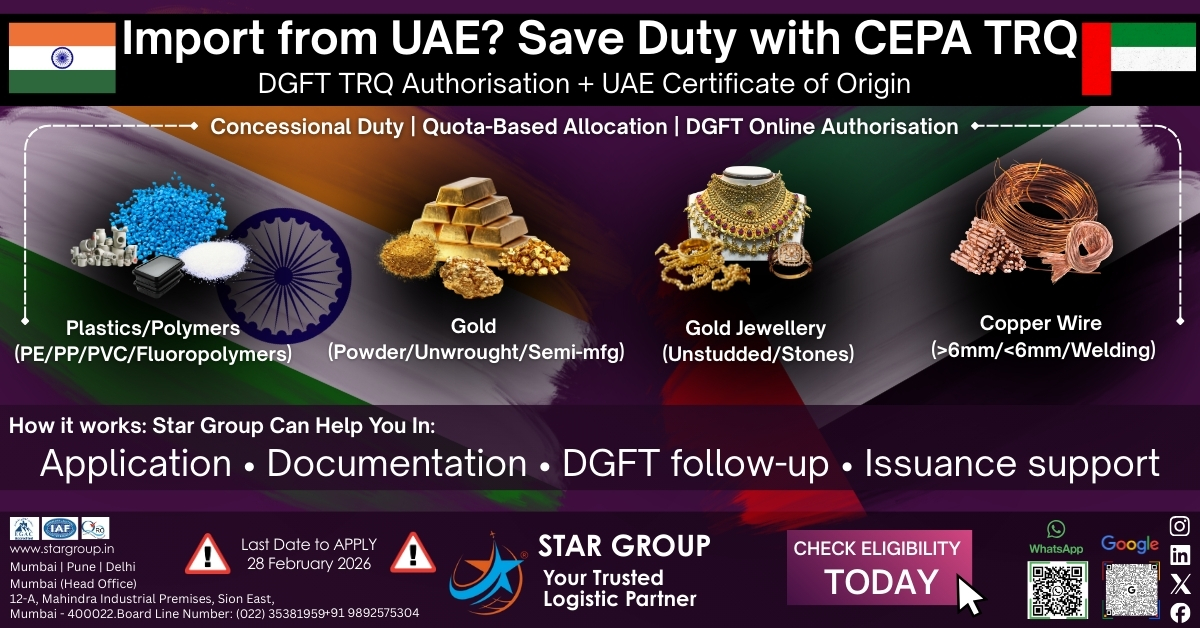
How to use DGFT TRQ authorisation to import select items from UAE at concessional customs duty (with official rules + product snapshot) What is TRQ under India–UAE CEPA?Under the India–UAE Comprehensive Economic Partnership Agreement (CEPA), certain produ...
Country-wise TRQ Items Covered Under Sri Lanka, Mauritius, Nepal, UAE & MercosurThe Directorate General of Foreign Trade (DGFT), Ministry of Commerce & Industry, has issued Public Notice No. 50/2025-26 dated 24 February 2026, extending the deadline for fi...
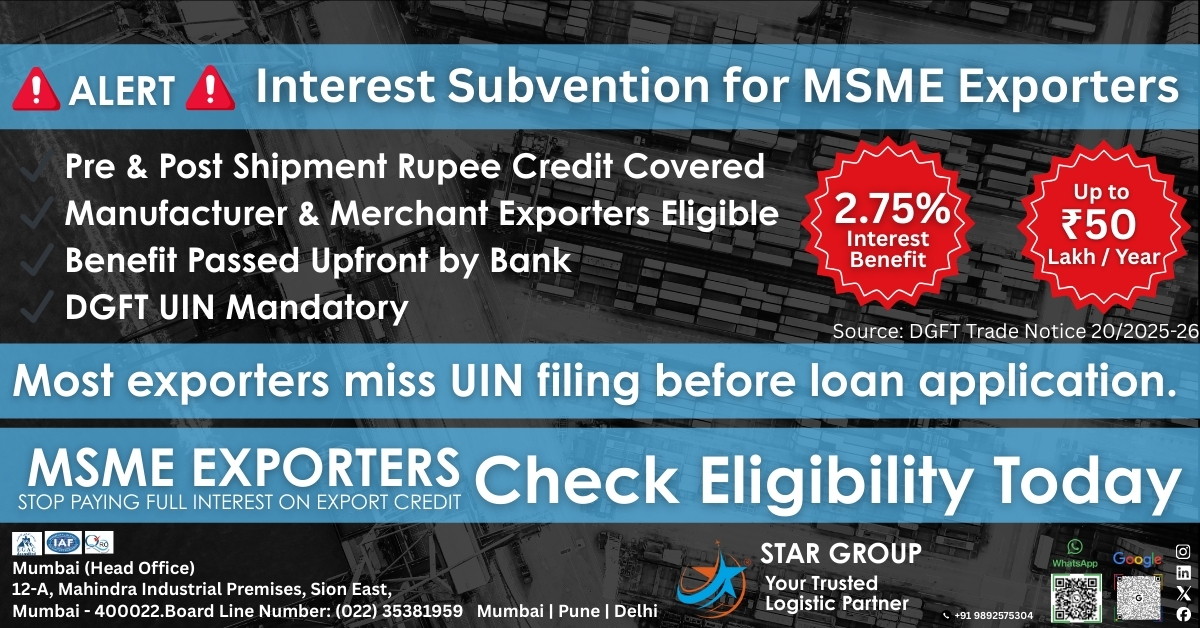
OverviewDGFT has launched “Interest Subvention for Pre- and Post-Shipment Export Credit” under the Export Promotion Mission (EPM) – Niryat Prothsahan through Trade Notice No. 20/2025-26 dated 02 January 2026, with immediate effect. The intervention is ope...
Do you know that the Government of India now allows eligible importers to pay customs duty after 30 days instead of paying it upfront?In a major relief for compliant importers and domestic manufacturers, the Central Board of Indirect Taxes and Customs (CB...
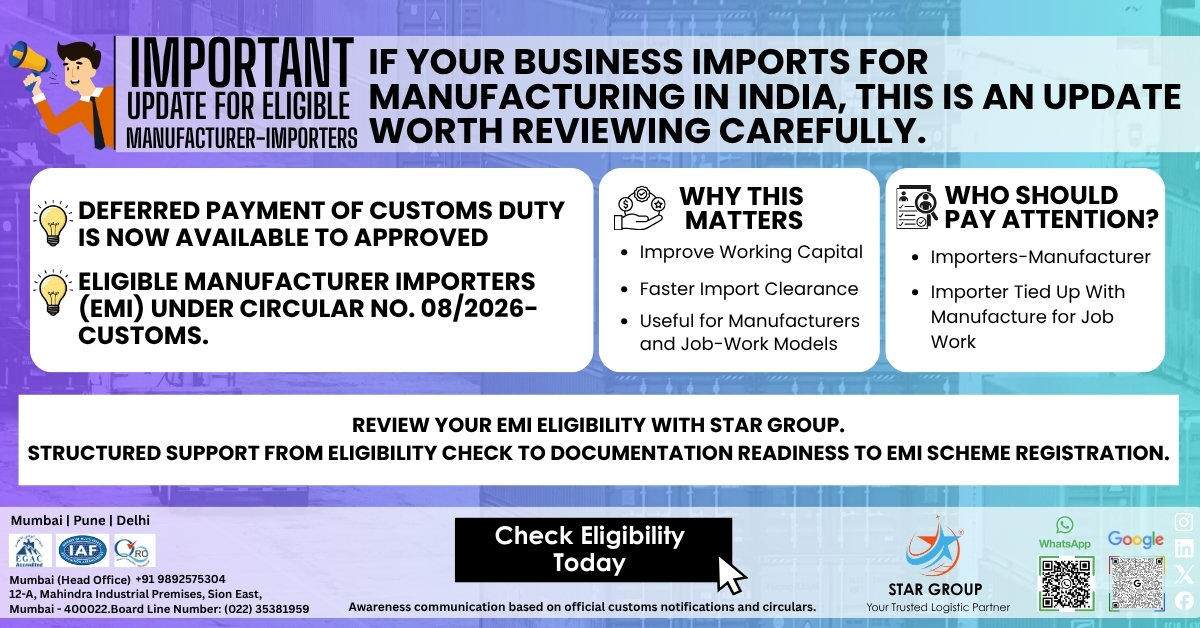
The Central Board of Indirect Taxes and Customs (CBIC) has introduced an important facilitation measure for eligible manufacturer-importers through the Eligible Manufacturer Importer (EMI) Scheme. Under this framework, approved EMI entities can clear impo...
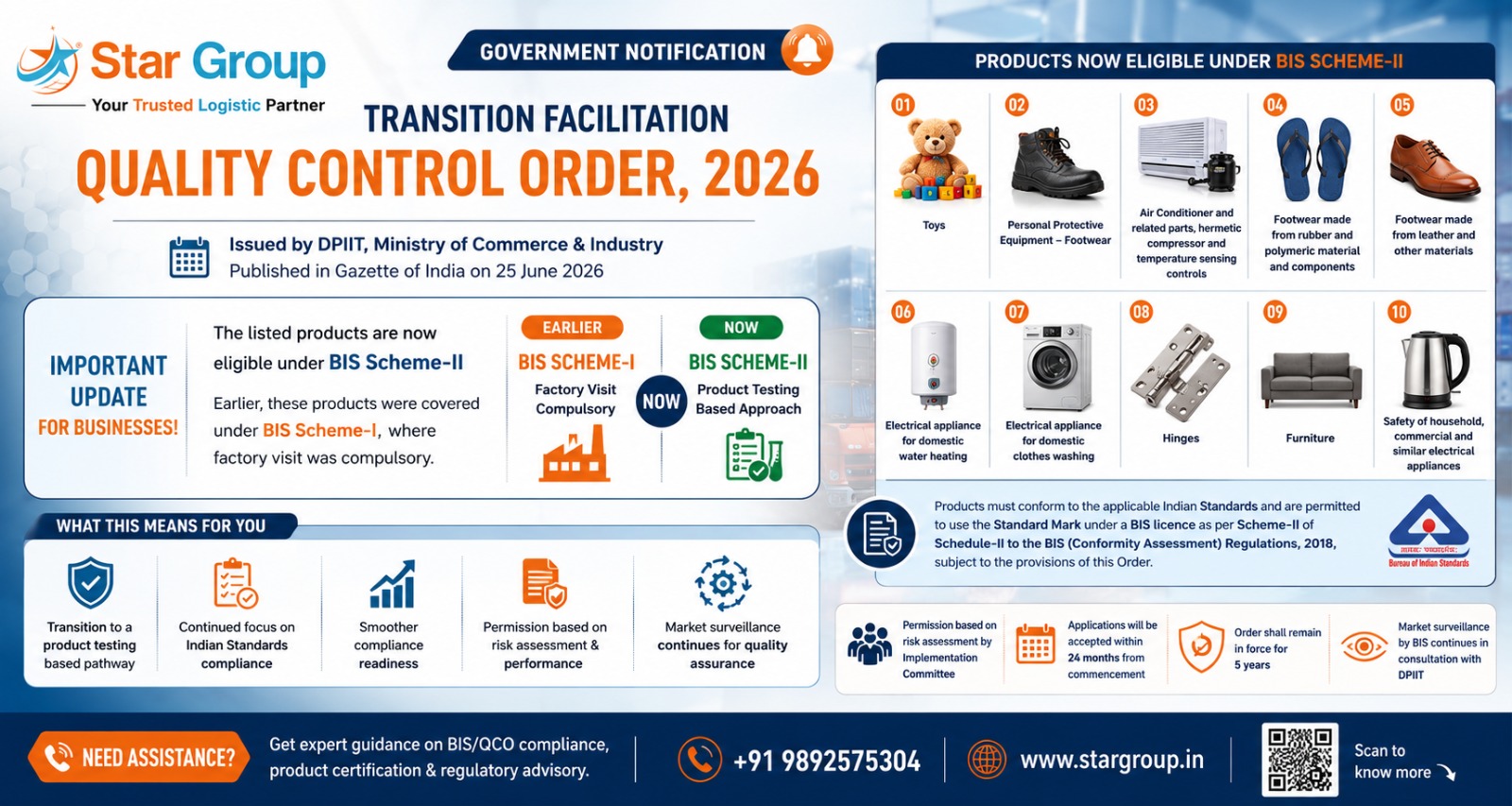
The Ministry of Commerce and Industry, through the Department for Promotion of Industry and Internal Trade (DPIIT), has notified the Transition Facilitation (Quality Control) Order, 2026.This notification is important for businesses dealing with selected ...
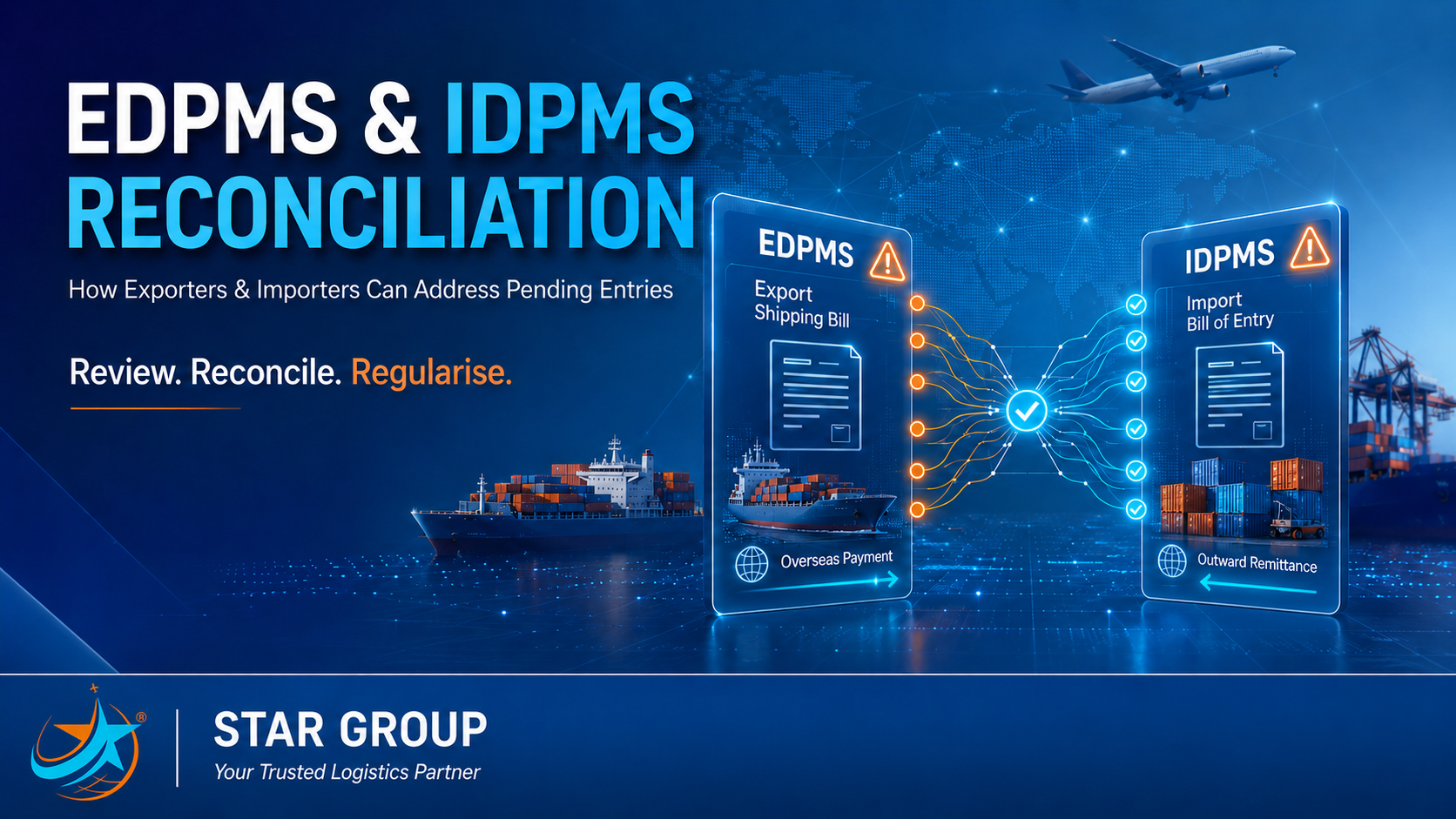
An export payment may have been received—or an import payment completed—yet the related Shipping Bill or Bill of Entry may still appear as outstanding in the banking system.These pending records can arise from missing documents, incorrect references, diff...
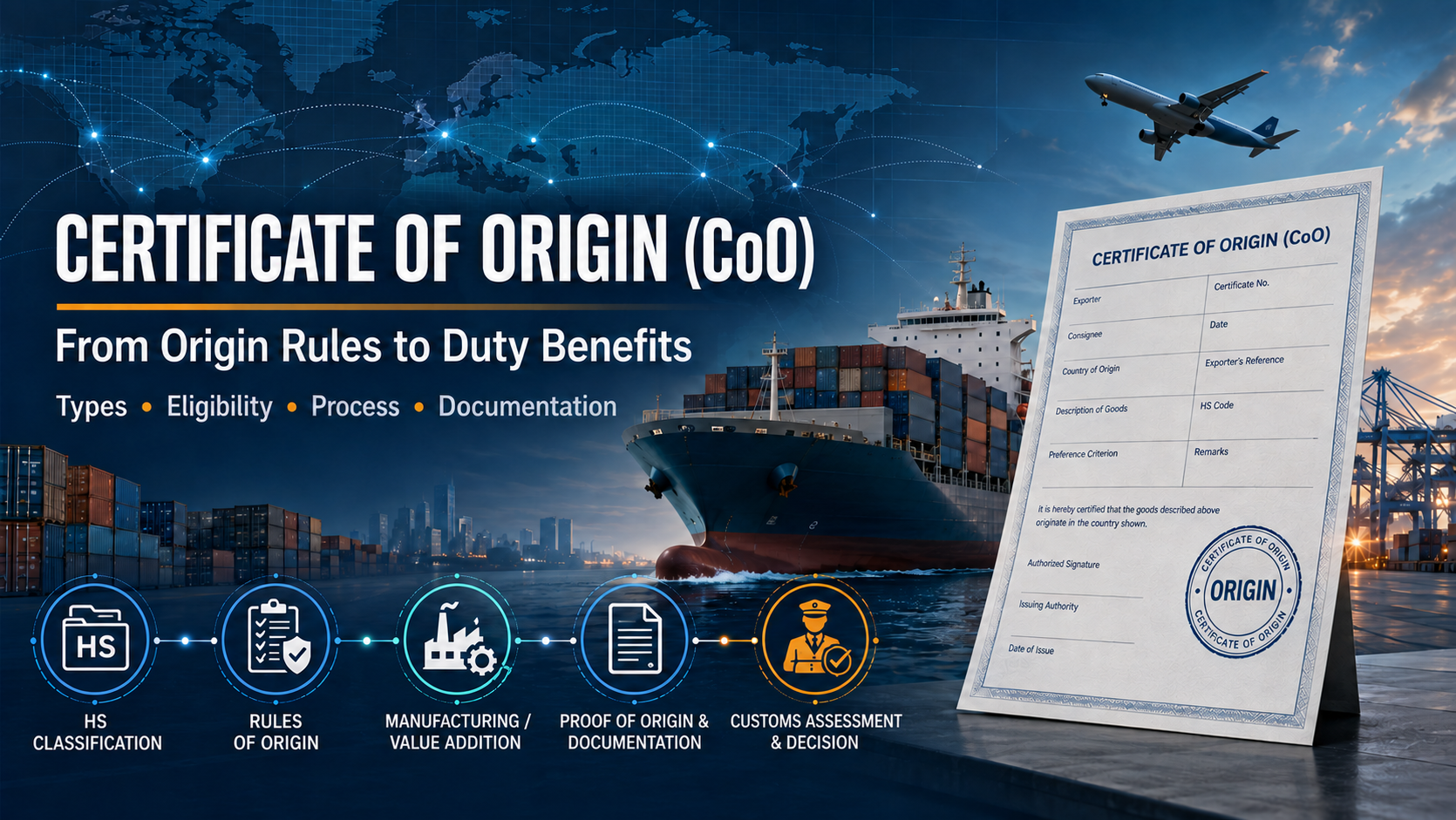
In international trade, the country from which goods are shipped is not always their country of origin.A product may be exported from India, contain inputs sourced from several countries and still qualify—or fail to qualify—as Indian-origin, depending on ...
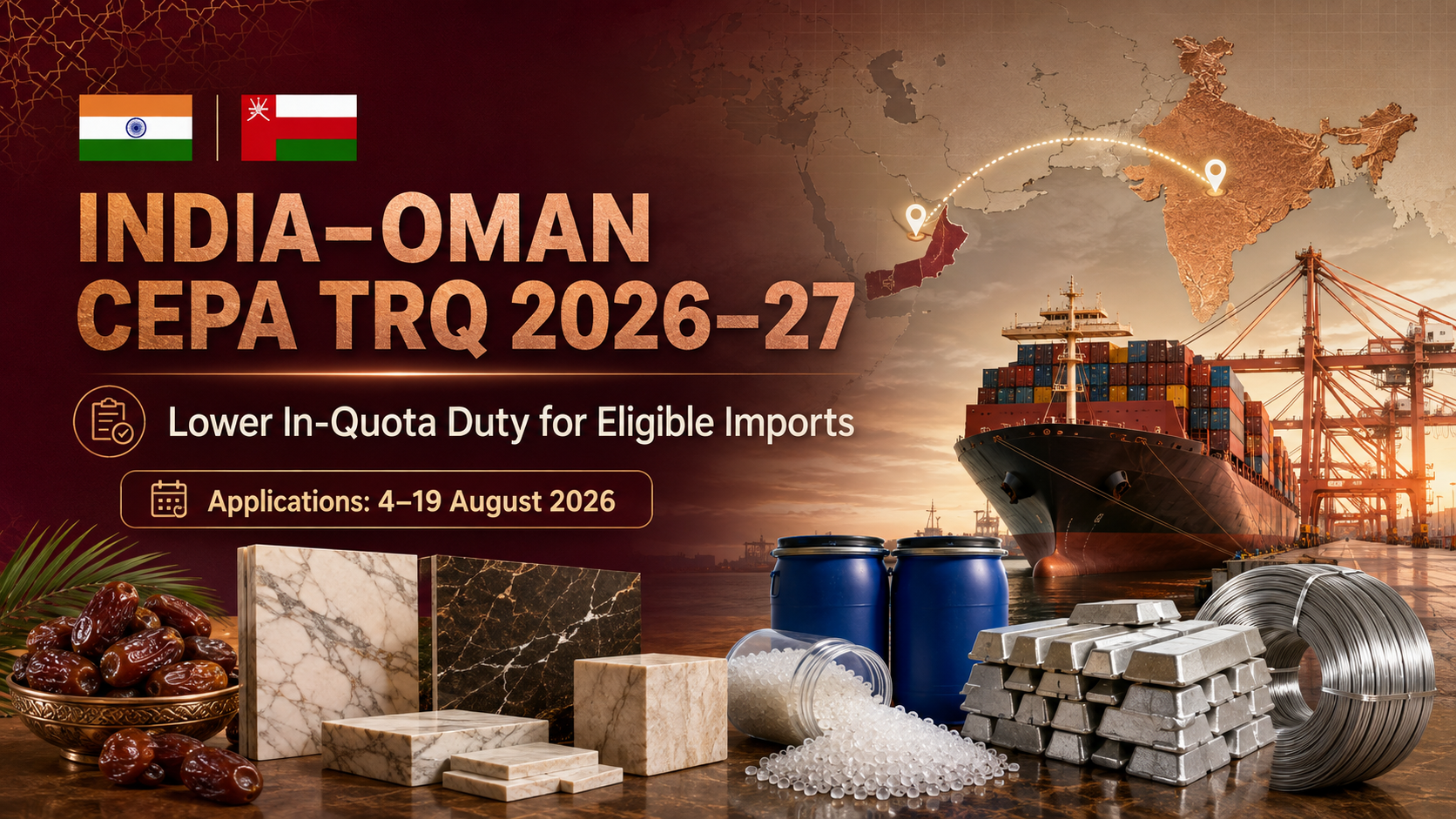
The Directorate General of Foreign Trade (DGFT) has invited applications for Tariff Rate Quota (TRQ) allocation under the India–Oman Comprehensive Economic Partnership Agreement (CEPA) for FY 2026–27.Applications can be submitted from 4 August 2026 to 19 ...
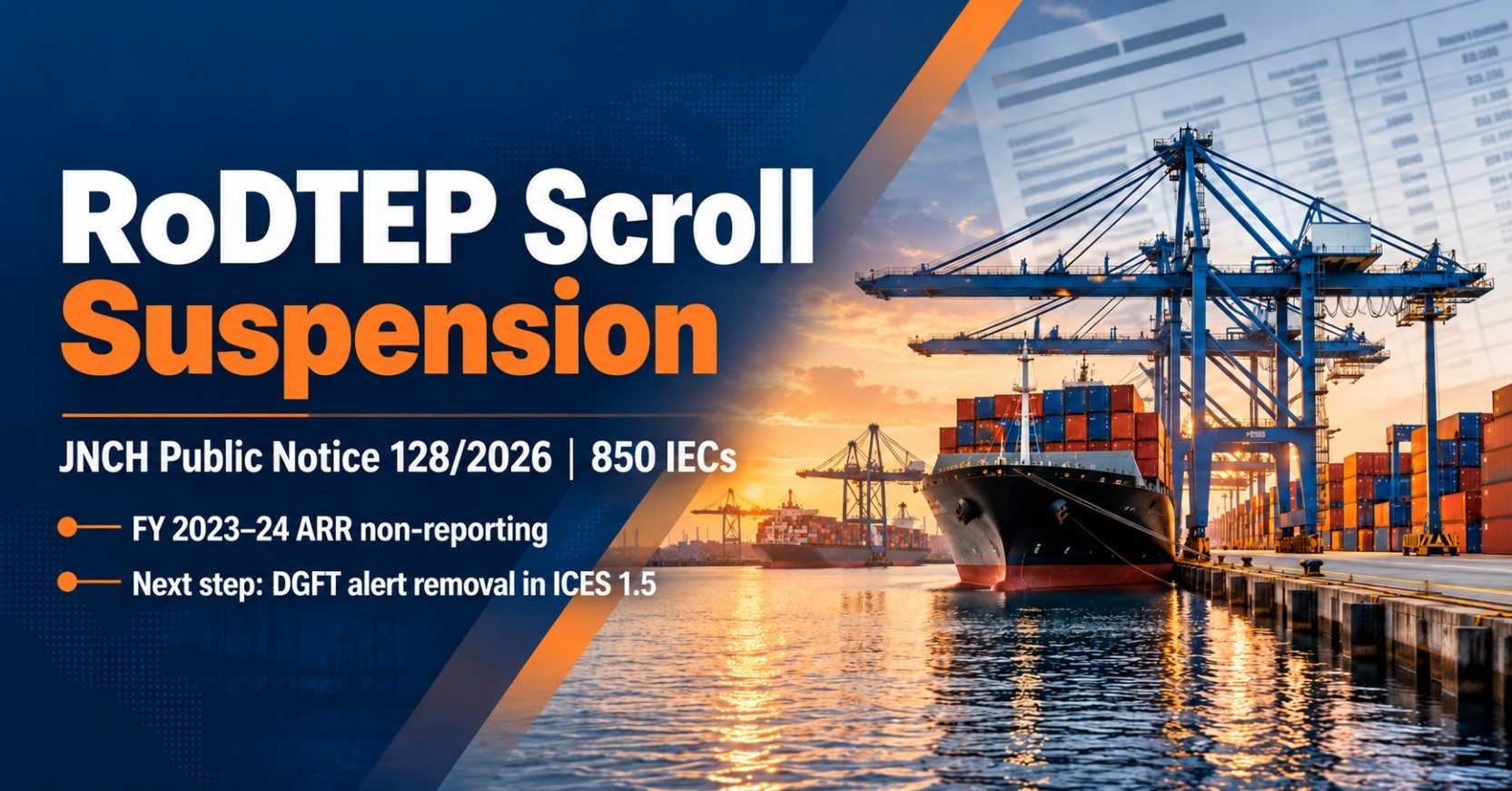
Jawaharlal Nehru Custom House (JNCH), Nhava Sheva, issued Public Notice No. 128/2026 on 8 October 2026 after receiving representations about RoDTEP scrolls not being generated for certain Shipping Bills. The issue related to alerts or suspension shown aga...