Fueling Self-Reliance: India’s Push for Lithium-Ion Battery Manufacturing
February 22, 2025
The Union Budget 2025 has introduced a significant push for domestic manufacturing and value addition, particularly in the lithium-ion battery sector. With a growing emphasis on electric mobility and self-reliance, Finance Minister Nirmala Sitharaman announced the addition of:
35 new capital goods under customs tax exemption for EV battery manufacturing 28 new capital goods under the exemption for mobile phone battery manufacturing.
"In a major boost to domestic manufacturing, the government has extended customs duty exemptions to an additional 64 capital goods, which were previously subjected to Basic Customs Duty (BCD) ranging from 7.5% to 15%. With this exemption, manufacturers can now access these essential goods at lower costs, fostering greater investment, technological advancement, and local value addition in India’s rapidly growing battery and electronics sectors."
Here is the list of capital goods exempted fully along with a notification snapshot:
28 new capital goods under the exemption for mobile phone battery manufacturing.
Sr. No.
Name of Capital Goods
Sr. No.
Name of Capital Goods
1
Auto-taping machine
15
Film / Myler tearing machine
2
Auto-packing machine
16
Auto unloading Machine
3
Mylar sticking machine
17
Mylar slitting machine
4
Auto magazine load machine
18
Foil slitting machine
5
Constant temperature capacity machine
19
Dust collector
6
Separator coating machine
20
Electrode packing machine
7
Roller cleaning machine
21
Electrode rewinding machine
8
Formation machine
22
Calendar printing machine
9
Automatic tapping machine
23
Electrolyte tapping machine
10
Stacking machine
24
Strip Tape machine
11
Separator trimming machine
25
Mixing or agitating substances machine
12
Tab transfer welding & winding machine
26
Aluminum foil bag edge cutting machine
13
Ultrasonic Tray cleaning machine
27
Ultrasonic cleaning machine
14
Gasket automatic cleaning machine
28
Cell slicing machine
35 new capital goods under customs tax exemption for EV battery manufacturing
S.No.
Name of Capital Goods
S.No.
Name of Capital Goods
1
Solvent Recovery System
19
2nd Helium Test System
2
Heat Recovery System
20
Wire Feeding and Rework Machine
3
Effluent Treatment System
21
Cell Aging Machine
4
Electrolyte Injection Machine
22
Negative Pressure Formation
5
Helium Injection Machine
23
Cell Formation - Cell Capacity and SOC
6
Nail Inserting Machine
24
Cell Formation - DCIR
7
Nail Pulling Machine
25
Cell Formation - Cell Tray Plastic
8
Injection Hole Cleaning Machine
26
Cell Formation - Cell Tray
9
Cell Baking & Cooling Machine
27
Cell Formation - Metallic Formation Machine
10
Jelly Roll Pairing Machine
28
Cell Formation - Other Trays
11
Mylar Wrapping Machine
29
Film Wrapping and Final Inspection
12
Cell Sorting Line
30
Tap to Top Cap Welding
13
Laser Pin Welding
31
Fibre Temperature Detection System
14
Laser Notching & Winding
32
Water Sprinkler System
15
Ultrasonic Welding
33
Rack
16
Load in Can
34
Tape Coding
17
Top Cover Laser Welding
35
Wire Filling and Welding Machine
18
1st Helium Test System
This strategic move is set to enhance India's production capabilities, reduce import dependency, and drive innovation in the clean energy ecosystem.
Key Benefits of the Policy
Encouraging Local Production: The exemption lowers manufacturing costs, making India a competitive hub for battery production.
Strengthening the EV Ecosystem: Affordable lithium-ion batteries will accelerate EV adoption and promote sustainable transportation.
Attracting Investments & Generating Employment: Lower costs and improved infrastructure will bring in global investors and create new jobs in the sector.
Enhancing Technological Innovation: Encouraging domestic R&D in battery technology for longer-lasting, more efficient, and cost-effective solutions.
In this article, we are going to have a look at all the necessary documents required for the import and export procedure to be completed successfully.These import and export documents are essential to be kept in mind while importing or exporting goods.Let...
The Export clearance procedure is an important step while exporting goods from India.Customs Clearance is the process of authorization of a person or goods by the Customs Department.The authorization takes place after providing the proper customs clearanc...
In this article, we are going to discuss in detail the procedure of Import and Export in India.The Foreign Trade (Development and Regulation) Act, 1992, of India regulates the import and export of goods. It also facilitates the government to make necessar...
Advance Ruling is Trade Facilitation as per WTO agreementImporters and Exporters who have ambiguity about their goods Classification, Duty structure and Valuation method can go for Advance Ruling. Advance Ruling will ensure tariff classification, exemptio...
Duty Free Import Authorization Scheme (DFIA) ObjectiveThis scheme providing duty free inputs on post exports basis as a replenishment so that export product becomes competitive in the international market.DFIA is freely transferable. Eligibility Criteria...
Self-Sealing Permission Purpose Central Board of Indirect Taxes and Custom (CBIC ) has approved the program to promote exports Self Sealing Permission earlier was called as Factory Stuffing Permission; this permits containerize cargo to seal at their fact...
RESTRICTED LICENSEAs per the provisions of Exim Policies, The Central Government, in public interest, regulates the import or export of goods by means of a Negative List. This Negative Lists consist of goods for Export & import which are prohibited or res...
Brand Rate Fixation (Custom Act Section 75) When the manufacturer import the Raw material, Components & packing material after paying the Basic Custom Duty (BCD) & Social Welfare Surcharge (SWS) and utilizing the same for the manufacturing of export produ...
Preferential Trade Agreements A key benefit under PTA is preferential tariff, i.e. applicability of lower customs duty on import of goods from partner countries. India has notified separate rules for determining whether goods being imported from a country...
Status Holder Certificate All exporters of goods & services having an import-export code (IEC) number shall be eligible for recognition as a status holder on achieving specific turnover. Status recognition depends upon export performance An applicant shal...
Re- Import of Goods without payment of Duty Re-importing goods without payment of duty is allowed under various Customs notifications. Goods that were earlier exported can be brought back into the country without payment of import duties and taxes.Common...
Import of Goods for display in Trade Fairs and events without payment of Customs Duty Conditions: The importer must submit a Specific declaration, Re- export bond with bank guarantee 10% of duty amount. Imports by government entities, diplomatic missions,...
The Union Budget 2025-26 has unveiled transformative measures to bolster India's Micro, Small, and Medium Enterprises (MSMEs), recognizing their pivotal role in economic growth and employment generation.Enhanced MSME Classification CriteriaTo facilitate s...
IntroductionTo make international trade easier and more efficient for Indian businesses, the government has introduced a new digital platform called Bharat Trade Net (BTN). Announced during the Union Budget 2025, BTN aims to streamline trade processes, ma...
The Union Budget 2025-26 has introduced significant changes in customs duties related to the leather industry, benefiting both importers and exporters. Import of Wet Blue leather is now fully exempt from Basic Customs Duty (BCD).Export of Crust leather is...
The Union Budget 2025 has introduced a significant push for domestic manufacturing and value addition, particularly in the lithium-ion battery sector. With a growing emphasis on electric mobility and self-reliance, Finance Minister Nirmala Sitharaman anno...
The Indian government has taken a significant step towards strengthening the clean energy and electric vehicle (EV) sectors. In Budget 2025, Finance Minister Nirmala Sitharaman announced the exemption of customs duty on cobalt powder & waste, scrap of lit...
IntroductionIn today's rapidly evolving industrial landscape, ensuring the safety and quality of machinery and electrical equipment is paramount. The Bureau of Indian Standards (BIS) introduced Scheme X under the Conformity Assessment Regulations to addre...
The Ministry of Food Processing Industries (MoFPI), Government of India has issued a Notice Inviting Proposals for financial assistance to set up multi-product food irradiation units under the component scheme “Integrated Cold Chain and Value Addition Inf...
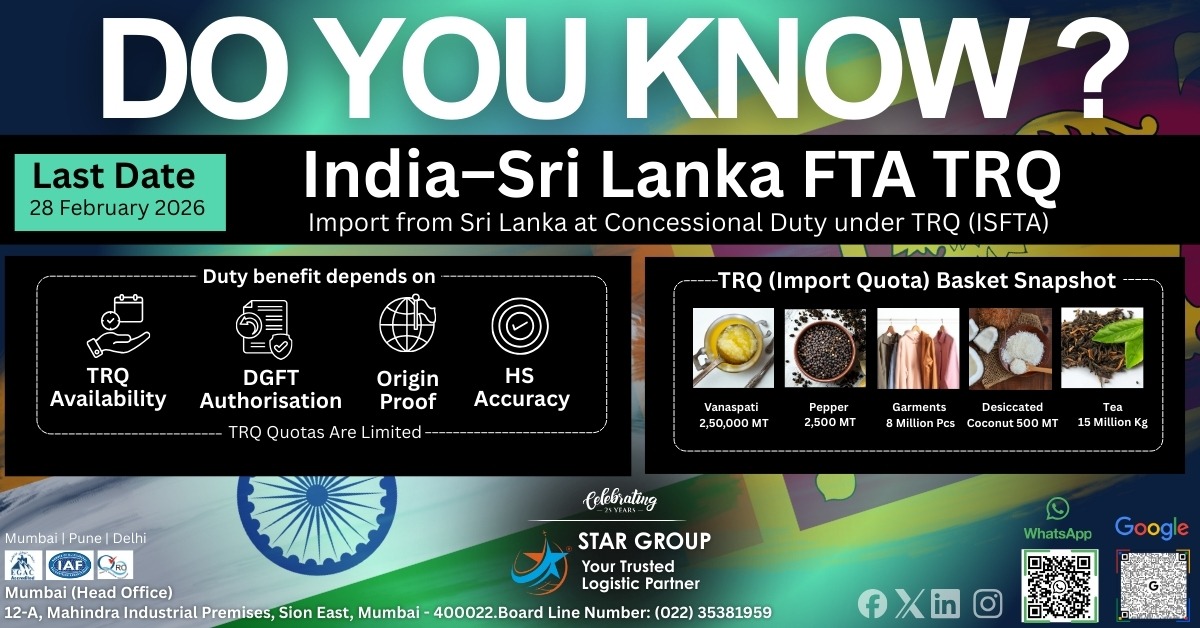
Under the India–Sri Lanka Free Trade Agreement (ISFTA), certain Sri Lanka–origin goods can be imported into India under a Tariff Rate Quota (TRQ) at concessional or Nil Customs duty. Once the notified annual quota is exhausted, imports attract normal tari...
Under the India–Mauritius CECPA, select products can be imported into India under a Tariff Rate Quota (TRQ). TRQ allows importers to claim a preferential in-quota duty rate for a notified quantity, subject to DGFT procedure and Customs compliance. What i...
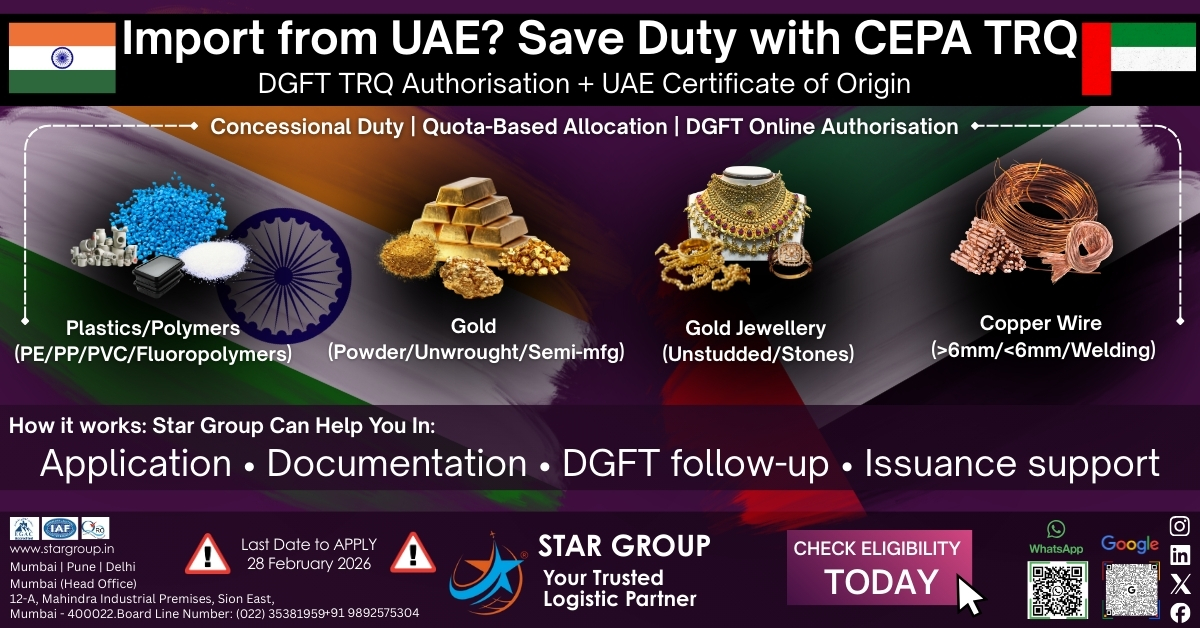
How to use DGFT TRQ authorisation to import select items from UAE at concessional customs duty (with official rules + product snapshot) What is TRQ under India–UAE CEPA?Under the India–UAE Comprehensive Economic Partnership Agreement (CEPA), certain produ...
Country-wise TRQ Items Covered Under Sri Lanka, Mauritius, Nepal, UAE & MercosurThe Directorate General of Foreign Trade (DGFT), Ministry of Commerce & Industry, has issued Public Notice No. 50/2025-26 dated 24 February 2026, extending the deadline for fi...
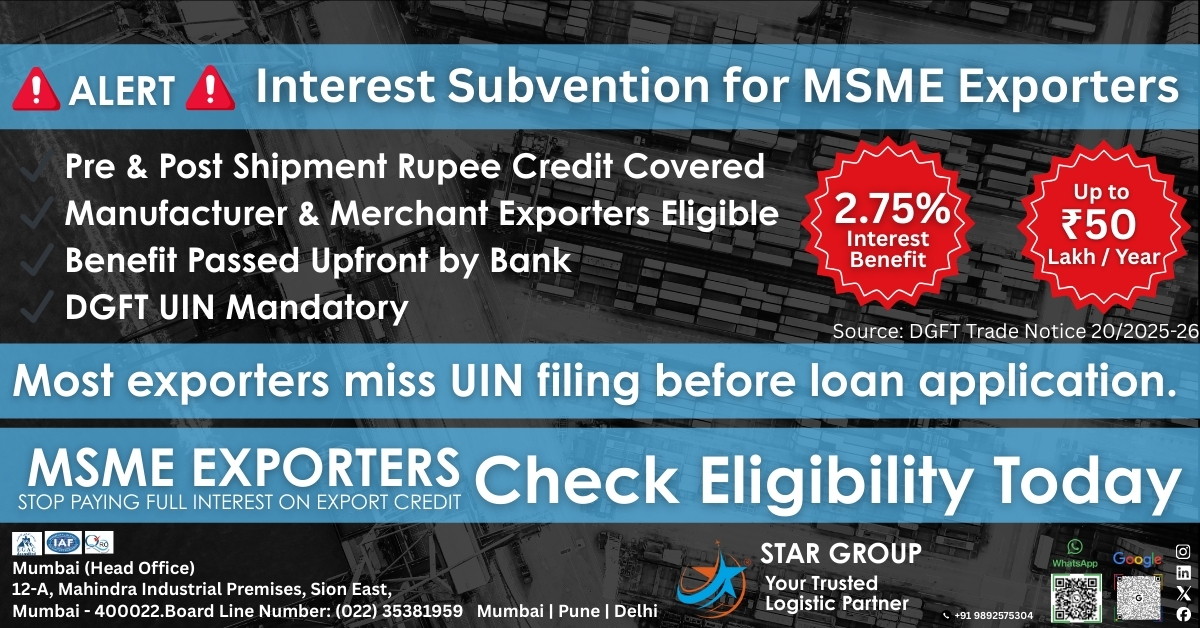
OverviewDGFT has launched “Interest Subvention for Pre- and Post-Shipment Export Credit” under the Export Promotion Mission (EPM) – Niryat Prothsahan through Trade Notice No. 20/2025-26 dated 02 January 2026, with immediate effect. The intervention is ope...
Do you know that the Government of India now allows eligible importers to pay customs duty after 30 days instead of paying it upfront?In a major relief for compliant importers and domestic manufacturers, the Central Board of Indirect Taxes and Customs (CB...
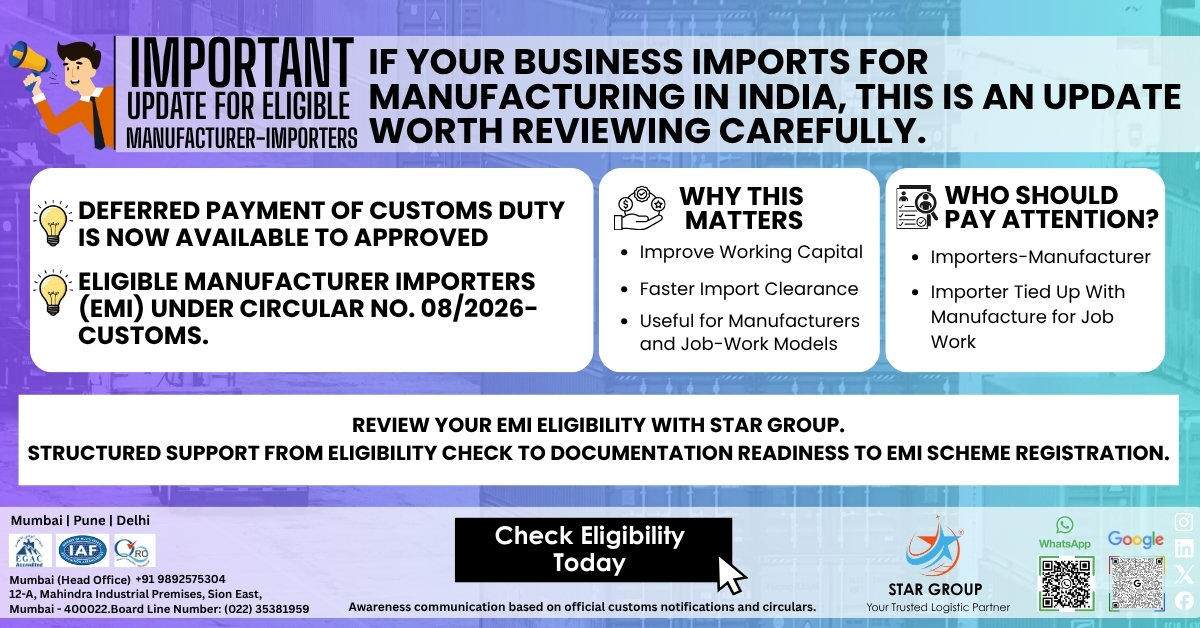
The Central Board of Indirect Taxes and Customs (CBIC) has introduced an important facilitation measure for eligible manufacturer-importers through the Eligible Manufacturer Importer (EMI) Scheme. Under this framework, approved EMI entities can clear impo...
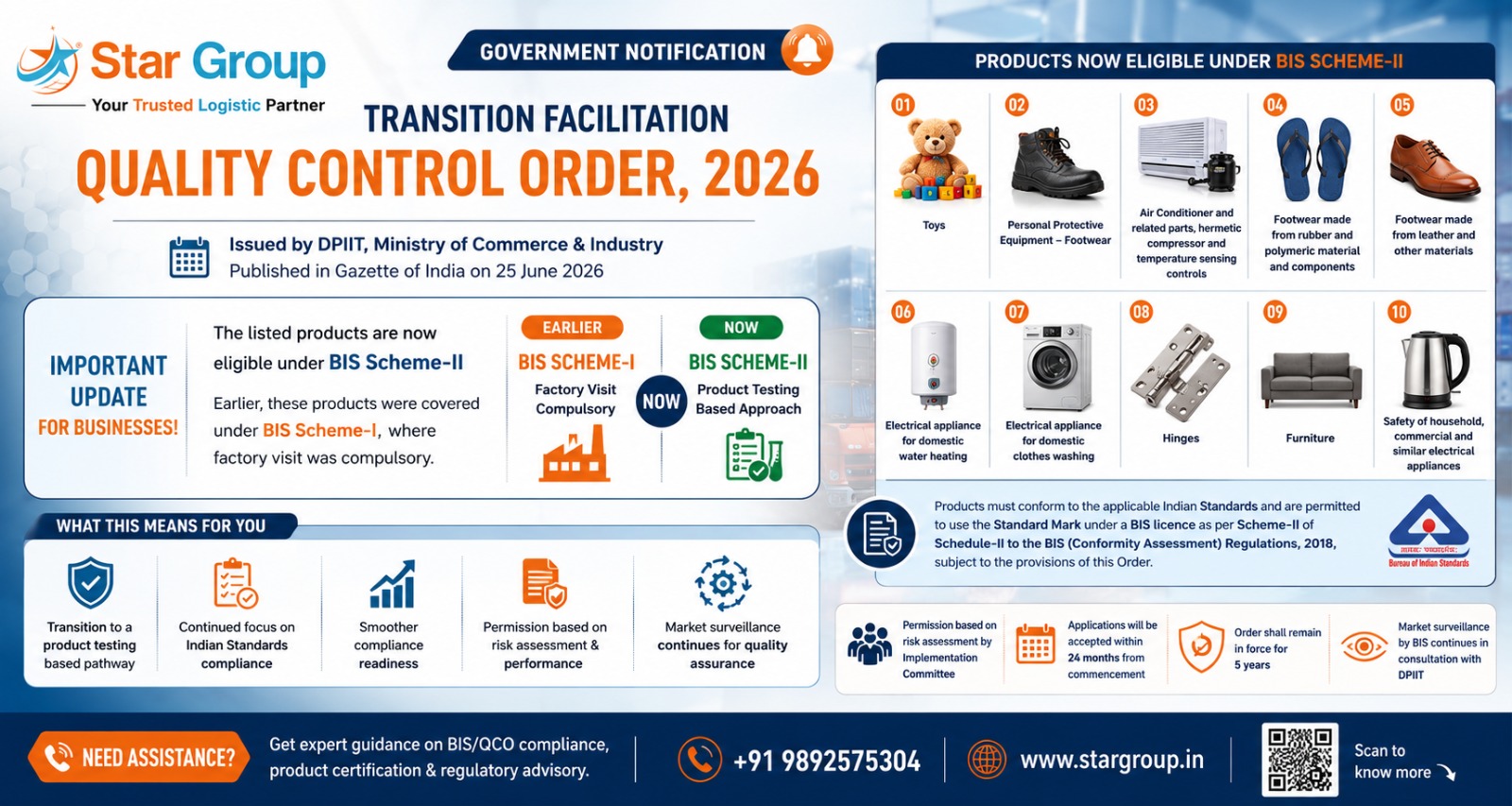
The Ministry of Commerce and Industry, through the Department for Promotion of Industry and Internal Trade (DPIIT), has notified the Transition Facilitation (Quality Control) Order, 2026.This notification is important for businesses dealing with selected ...
An export payment may have been received—or an import payment completed—yet the related Shipping Bill or Bill of Entry may still appear as outstanding in the banking system.These pending records can arise from missing documents, incorrect references, diff...
In international trade, the country from which goods are shipped is not always their country of origin.A product may be exported from India, contain inputs sourced from several countries and still qualify—or fail to qualify—as Indian-origin, depending on ...
The Directorate General of Foreign Trade (DGFT) has invited applications for Tariff Rate Quota (TRQ) allocation under the India–Oman Comprehensive Economic Partnership Agreement (CEPA) for FY 2026–27.Applications can be submitted from 4 August 2026 to 19 ...
Jawaharlal Nehru Custom House (JNCH), Nhava Sheva, issued Public Notice No. 128/2026 on 8 October 2026 after receiving representations about RoDTEP scrolls not being generated for certain Shipping Bills. The issue related to alerts or suspension shown aga...