
Transition Facilitation (Quality Control) Order, 2026: What Businesses Should Know

June 30, 2026
Transition Facilitation (Quality Control) Order, 2026: What Businesses Should Know

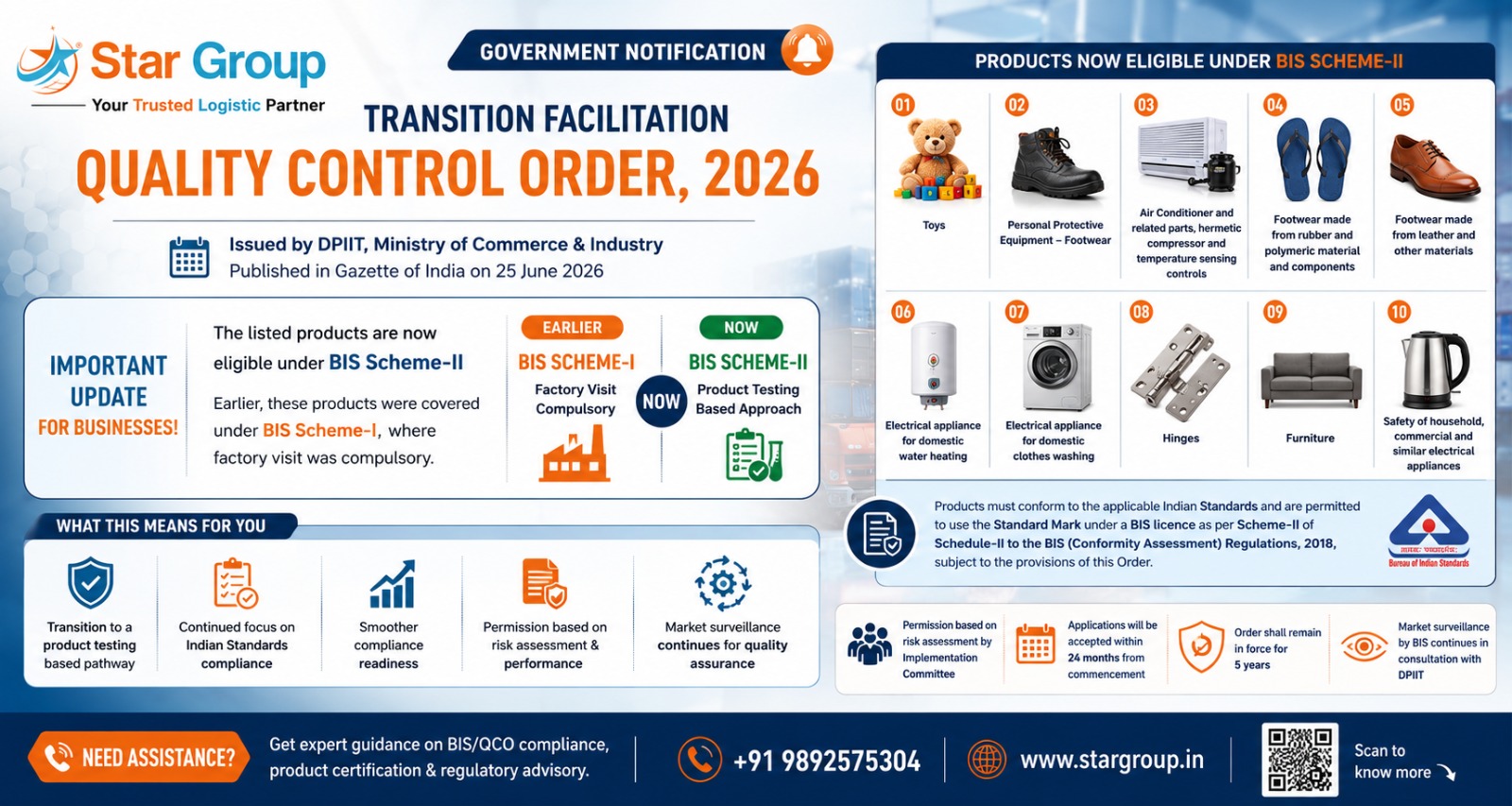
The Ministry of Commerce and Industry, through the Department for Promotion of Industry and Internal Trade (DPIIT), has notified the Transition Facilitation (Quality Control) Order, 2026.

This notification is important for businesses dealing with selected product categories covered under specified Quality Control Orders. The key business-level shift is that the listed products are now covered under a Scheme-II based transition facilitation pathway, subject to the conditions of the notification.

Earlier, many such product categories were understood under the BIS Scheme-I route, where factory visit and manufacturing-premises assessment played a significant role. Under this notification, the listed product categories are now permitted under BIS Scheme-II, creating a more product-testing-oriented transition route for eligible businesses, while still keeping Indian Standards compliance and regulatory oversight in place.

This is not a blanket exemption. It is a structured compliance facilitation framework.

What is the Transition Facilitation (Quality Control) Order, 2026?

The Transition Facilitation (Quality Control) Order, 2026 applies to goods or articles covered under the Quality Control Orders listed in the schedule of the notification.

As per the notification, the covered goods or articles must conform to the corresponding Indian Standards. The use of the Standard Mark is permitted under a BIS licence as per Scheme-II of Schedule-II to the Bureau of Indian Standards (Conformity Assessment) Regulations, 2018, subject to the provisions of this Order.

In simple terms, this Order provides a transition pathway for specific QCO-covered product categories, allowing eligible companies to align their compliance under BIS Scheme-II, subject to permission, documentation, assessment, and monitoring requirements.

Key Change: BIS Scheme-I to BIS Scheme-II Pathway

For businesses, the most important point to understand is the shift in compliance approach.

Earlier PositionCurrent Position Under the Notification
Products were generally associated with BIS Scheme-I compliance routeListed products are now eligible under BIS Scheme-II pathway under this Order
Factory visit was a key requirement under Scheme-I-based complianceScheme-II pathway allows a product-testing-oriented route for listed products
Compliance was strongly linked with manufacturing premises assessmentCompliance continues, but the transition pathway focuses on listed products under Scheme-II
Businesses had to prepare for factory-level certification requirementsBusinesses must now review product applicability, testing, documentation and permission requirements

This transition can help eligible businesses plan their compliance more clearly. However, the notification does not remove the responsibility to meet applicable Indian Standards.

Why This Notification Matters for Importers, Manufacturers and Businesses

The notification is relevant for companies dealing with listed QCO-covered products because it provides a more structured transition framework.

From a business and compliance point of view, this can help with:

Clearer understanding of the applicable BIS pathway

Better planning for eligible product categories

Product-testing-based compliance preparation

Documentation readiness

Reduced confusion around transition requirements

Better alignment with Indian Standards and Quality Control Orders

Early compliance planning before procurement, import, supply or distribution

However, businesses must remember that permission is not automatic. Eligibility, risk assessment, compliance history, product conformity, documentation and conditions specified under the Order remain important.

Product Categories Covered Under the Notification
The schedule of the Transition Facilitation (Quality Control) Order, 2026 lists the following Quality Control Orders and product categories:

1. Toys

Products covered under the Toys (Quality Control) Order, 2020 are included in the schedule.

Businesses dealing with toys should review product standards, testing requirements, documentation and BIS Scheme-II applicability under this transition framework.

2. Personal Protective Equipment — Footwear

The notification includes Personal Protective Equipment — Footwear (Quality Control) Order, 2020.

This category is relevant for manufacturers, suppliers, importers and distributors dealing with safety footwear and PPE footwear products.

3. Air Conditioner and Related Parts

The notification includes:

Air Conditioner and its related parts, hermetic compressor and temperature sensing controls.

This category is relevant for businesses dealing with air-conditioning units, AC components, compressors and temperature sensing controls covered under the listed QCO.

4. Footwear Made from Rubber and Polymeric Material and Components

The schedule includes footwear made from all rubber and all polymeric material and its components.

This is important for companies dealing with rubber footwear, polymeric footwear and related components.

5. Footwear Made from Leather and Other Materials

The notification also includes footwear made from leather and other materials.

Businesses in footwear manufacturing, importing, private labelling, retail supply chains and distribution should review applicability carefully.

6. Electrical Appliance for Domestic Water Heating

The notification covers electrical appliances for domestic water heating.

This may be relevant for companies dealing with water heaters and similar domestic electrical heating products covered under the applicable QCO.

7. Electrical Appliance for Domestic Clothes Washing

The schedule includes electrical appliances for domestic clothes washing.

Businesses handling washing machines or similar covered products should review BIS Scheme-II applicability and testing requirements.

8. Hinges

The notification includes Hinges (Quality Control) Order, 2025.

This is relevant for businesses dealing with hinges used in furniture, doors, fixtures, industrial applications and related supply chains, subject to the applicable QCO.

9. Furniture

The notification covers Furniture (Quality Control) Order, 2025.

Businesses engaged in furniture manufacturing, importing, institutional supply, office furniture, retail furniture or contract furnishing should assess whether their products fall under the listed QCO.

10. Safety of Household, Commercial and Similar Electrical Appliances

The notification also includes Safety of Household, Commercial and Similar Electrical Appliances (Quality Control) Order, 2026.

This category can be relevant for businesses dealing with household, commercial and similar electrical appliances covered under the applicable safety standards.

Who May Seek Permission Under the Order?

As per the notification, permission under the Order may be granted by DPIIT to a person that is a company incorporated under the Companies Act, 2013.

The permission is based on risk assessment by an Implementation Committee constituted under the Order.

Therefore, businesses should not treat this as automatic eligibility. Companies must review:

Whether the product is covered under the listed QCOs

Whether the company falls within the eligible applicant category

Whether the product conforms to applicable Indian Standards

Whether the documentation is complete

Whether the business can meet permission conditions

Whether compliance and supply chain records are properly maintained

Role of the Implementation Committee

The notification provides for an Implementation Committee for assessment under the Order.

The Committee may evaluate the applicant based on factors such as:

Technical capability

Demonstrated experience

Quality assurance across the supply chain

Control over design and manufacturing

Compliance integrity

Conduct history

Commitment to building supply chain capabilities in India

Technology adoption, advancement, design capability or research and development

Compliance with the concerned QCO for a continuous period of three years without default

Other relevant factors

This means companies should not look at this only as a product-testing matter. A complete compliance profile may be important.

Application Window Under the Notification

The notification states that applications for permission under the Order shall be accepted within 24 months from the date of commencement of the Order.

Businesses dealing with covered product categories should therefore begin reviewing applicability, documentation, product standards and compliance readiness in advance.

Duration of the Order

The Order shall remain in force for a period of five years from the date of commencement, unless extended by the Central Government through notification in the Official Gazette.

Any permission granted before rescission may continue to remain valid for the period specified in the permission, unless suspended, modified or withdrawn as per the provisions of the Order.

Practical Business Benefits of the Notification

From a business perspective, the Transition Facilitation (Quality Control) Order, 2026 may help eligible companies in the following ways:

1. Clearer Compliance Pathway
The notification creates a defined transition facilitation route for listed QCO-covered product categories.

2. Product-Testing-Oriented Approach
The shift to BIS Scheme-II for the listed products creates a more product-testing-focused pathway compared to the earlier Scheme-I route where factory visit was a significant requirement.

3. Better Planning for Eligible Companies
Companies can review product categories, documentation and compliance requirements in a more structured manner.

4. Documentation Readiness
Since the application process, documentation, entitlements, monitoring and compliance details will be specified through DPIIT guidelines, businesses can begin preparing product and compliance records early.

5. Improved Compliance Awareness
The notification encourages businesses to proactively assess product applicability and avoid last-minute compliance gaps. 

Disclaimer

This article is for general awareness and informational purposes only. It is based on the Transition Facilitation (Quality Control) Order, 2026.

Frequently Asked Questions

The Transition Facilitation (Quality Control) Order, 2026 is a notification issued by DPIIT for selected goods or articles covered under specified Quality Control Orders. It provides a transition facilitation framework under which listed products are permitted under BIS Scheme-II, subject to the provisions and conditions of the Order.

The main change is that listed product categories are now eligible under BIS Scheme-II under this transition framework. Earlier, many such products were associated with BIS Scheme-I, where factory visit was a key requirement. Under this notification, the listed products have a Scheme-II pathway, which is more product-testing-oriented.

No. BIS compliance continues to remain important. Products must conform to applicable Indian Standards, and permission is subject to conditions under the Order.

No. Permission is not automatic. DPIIT may grant permission to eligible companies based on risk assessment by the Implementation Committee and subject to specified conditions.

The notification covers listed QCO categories including toys, PPE footwear, air conditioners and related parts, rubber and polymeric footwear, leather footwear, domestic water heating appliances, domestic clothes washing appliances, hinges, furniture and safety of household, commercial and similar electrical appliances.

BIS Scheme-I is generally associated with the traditional ISI Mark product certification framework, where assessment of manufacturing premises, factory visit, inspection and testing systems are significant parts of the certification and surveillance process.

BIS Scheme-II is a conformity assessment route under the BIS framework. In the context of this notification, listed products are permitted under Scheme-II, creating a product-testing-oriented transition pathway, subject to the provisions of the Order.

Applications for permission under the Order may be accepted within 24 months from the date of commencement of the Order.

The Order will remain in force for five years from the date of commencement, unless extended by the Central Government through notification in the Official Gazette.

Yes. In case of breach of conditions, misrepresentation of material facts or failure of product conformity with applicable Indian Standards, the Central Government may suspend, modify or withdraw permission after giving an opportunity to be heard.

Businesses should review product category, applicable Indian Standards, BIS Scheme-II applicability, product testing readiness, documentation, supply chain records and DPIIT guidelines before proceeding.

Yes. Star Group can assist businesses with QCO applicability review, BIS Scheme-I and Scheme-II understanding, product-category mapping, documentation preparedness and compliance advisory.

Have any doubts? Please fill the form below to get in touch with us.

Related Blogs

What are the documents required for import & export

What are the documents required for import & export

April 04, 2022

In this article, we are going to have a look at all the necessary documents required for the import and export procedure to be completed successfully.These import and export documents are essential to be kept in mind while importing or exporting goods.Let...
What is the procedure of Custom Clearance for Export?

What is the procedure of Custom Clearance for Export?

April 04, 2022

The Export clearance procedure is an important step while exporting goods from India.Customs Clearance is the process of authorization of a person or goods by the Customs Department.The authorization takes place after providing the proper customs clearanc...

What is the procedure of import and export in India?

What is the procedure of import and export in India?

April 04, 2022

In this article, we are going to discuss in detail the procedure of Import and Export in India.The Foreign Trade (Development and Regulation) Act, 1992, of India regulates the import and export of goods. It also facilitates the government to make necessar...

Advance Ruling

Advance Ruling

September 18, 2024

Advance Ruling is Trade Facilitation as per WTO agreementImporters and Exporters who have ambiguity about their goods Classification, Duty structure and Valuation method can go for Advance Ruling. Advance Ruling will ensure tariff classification, exemptio...

Duty Free Import Authorization Scheme (DFIA)

Duty Free Import Authorization Scheme (DFIA)

October 02, 2024

Duty Free Import Authorization Scheme (DFIA) ObjectiveThis scheme providing duty free inputs on post exports basis as a  replenishment so that export product becomes competitive in the international market.DFIA is freely transferable. Eligibility Criteria...

Self-Sealing Permission ( SSP )

Self-Sealing Permission ( SSP )

October 03, 2024

Self-Sealing Permission Purpose Central Board of Indirect Taxes and Custom (CBIC ) has approved the program to promote exports Self Sealing Permission earlier was called as Factory Stuffing Permission; this permits containerize cargo to seal at their fact...

RESTRICTED LICENSE

RESTRICTED LICENSE

October 16, 2024

RESTRICTED LICENSEAs per the provisions of Exim Policies, The Central Government, in public interest, regulates the import or export of goods by means of a Negative List. This Negative Lists consist of goods for Export & import which are prohibited or res...

Brand Rate Fixation (Custom Act Section 75)

Brand Rate Fixation (Custom Act Section 75)

October 16, 2024

Brand Rate Fixation (Custom Act Section 75) When the manufacturer import the Raw material, Components & packing material after paying the Basic Custom Duty (BCD) & Social Welfare Surcharge (SWS) and utilizing the same for the manufacturing of export produ...

Preferential Trade Agreements

Preferential Trade Agreements

October 16, 2024

Preferential Trade Agreements A key benefit under PTA is preferential tariff, i.e. applicability of lower customs duty on import of goods from partner countries. India has notified separate rules for determining whether goods being imported from a country...

Status Holder Certificate

Status Holder Certificate

October 23, 2024

Status Holder Certificate All exporters of goods & services having an import-export code (IEC) number shall be eligible for recognition as a status holder on achieving specific turnover. Status recognition depends upon export performance An applicant shal...

Re- Import of Goods without payment of Duty

Re- Import of Goods without payment of Duty

October 23, 2024

 Re- Import of Goods without payment of Duty Re-importing goods without payment of duty is allowed under various Customs notifications. Goods that were earlier exported can be brought back into the country without payment of import duties and taxes.Common...

Import of Goods for display in Trade Fairs and events without payment of Customs Duty

Import of Goods for display in Trade Fairs and events without payment of Customs Duty

November 07, 2024

Import of Goods for display in Trade Fairs and events without payment of Customs Duty Conditions: The importer must submit a Specific declaration, Re- export bond with bank guarantee 10% of duty amount. Imports by government entities, diplomatic missions,...

Union Budget 2025: Boosting MSMEs with New Credit Schemes and Classification Changes

Union Budget 2025: Boosting MSMEs with New Credit Schemes and Classification Changes

February 21, 2025

The Union Budget 2025-26 has unveiled transformative measures to bolster India's Micro, Small, and Medium Enterprises (MSMEs), recognizing their pivotal role in economic growth and employment generation.Enhanced MSME Classification CriteriaTo facilitate s...

Understanding Bharat Trade Net (BTN): Simplifying India's International Trade

Understanding Bharat Trade Net (BTN): Simplifying India's International Trade

February 22, 2025

IntroductionTo make international trade easier and more efficient for Indian businesses, the government has introduced a new digital platform called Bharat Trade Net (BTN). Announced during the Union Budget 2025, BTN aims to streamline trade processes, ma...

India’s Budget 2025-26: Duty Exemptions to Boost the Leather Industry

India’s Budget 2025-26: Duty Exemptions to Boost the Leather Industry

February 22, 2025

The Union Budget 2025-26 has introduced significant changes in customs duties related to the leather industry, benefiting both importers and exporters. Import of Wet Blue leather is now fully exempt from Basic Customs Duty (BCD).Export of Crust leather is...

Fueling Self-Reliance: India’s Push for Lithium-Ion Battery Manufacturing

Fueling Self-Reliance: India’s Push for Lithium-Ion Battery Manufacturing

February 22, 2025

The Union Budget 2025 has introduced a significant push for domestic manufacturing and value addition, particularly in the lithium-ion battery sector. With a growing emphasis on electric mobility and self-reliance, Finance Minister Nirmala Sitharaman anno...

Budget 2025: Boost for Clean Energy – Duty Exemptions on Cobalt Powder &waste, Scrap of Lithium-Ion Battery & 12 Critical Minerals

Budget 2025: Boost for Clean Energy – Duty Exemptions on Cobalt Powder &waste, Scrap of Lithium-Ion Battery & 12 Critical Minerals

February 22, 2025

The Indian government has taken a significant step towards strengthening the clean energy and electric vehicle (EV) sectors. In Budget 2025, Finance Minister Nirmala Sitharaman announced the exemption of customs duty on cobalt powder & waste, scrap of lit...

Comprehensive Guide to BIS Scheme X Certification: Ensuring Safety and Compliance in Machinery and Electrical Equipment

Comprehensive Guide to BIS Scheme X Certification: Ensuring Safety and Compliance in Machinery and Electrical Equipment

September 04, 2025

IntroductionIn today's rapidly evolving industrial landscape, ensuring the safety and quality of machinery and electrical equipment is paramount. The Bureau of Indian Standards (BIS) introduced Scheme X under the Conformity Assessment Regulations to addre...

MoFPI Invites Proposals for Multi-Product Food Irradiation Units Under PMKSY: Eligibility, Grant Pattern & How to Apply

MoFPI Invites Proposals for Multi-Product Food Irradiation Units Under PMKSY: Eligibility, Grant Pattern & How to Apply

January 12, 2026

The Ministry of Food Processing Industries (MoFPI), Government of India has issued a Notice Inviting Proposals for financial assistance to set up multi-product food irradiation units under the component scheme “Integrated Cold Chain and Value Addition Inf...

India–Sri Lanka FTA TRQ (Import Quota): Notifications, Quota Limits & How to Use the Benefit

India–Sri Lanka FTA TRQ (Import Quota): Notifications, Quota Limits & How to Use the Benefit

February 13, 2026

Under the India–Sri Lanka Free Trade Agreement (ISFTA), certain Sri Lanka–origin goods can be imported into India under a Tariff Rate Quota (TRQ) at concessional or Nil Customs duty. Once the notified annual quota is exhausted, imports attract normal tari...

India–Mauritius CECPA TRQ for Indian Importers: Products, Quota, HS Codes & DGFT Process

India–Mauritius CECPA TRQ for Indian Importers: Products, Quota, HS Codes & DGFT Process

February 19, 2026

Under the India–Mauritius CECPA, select products can be imported into India under a Tariff Rate Quota (TRQ). TRQ allows importers to claim a preferential in-quota duty rate for a notified quantity, subject to DGFT procedure and Customs compliance.  What i...

India–UAE CEPA TRQ: DGFT Process, Eligible Importers, Product List & Duty Concessions

India–UAE CEPA TRQ: DGFT Process, Eligible Importers, Product List & Duty Concessions

February 20, 2026

How to use DGFT TRQ authorisation to import select items from UAE at concessional customs duty (with official rules + product snapshot) What is TRQ under India–UAE CEPA?Under the India–UAE Comprehensive Economic Partnership Agreement (CEPA), certain produ...

DGFT Extends TRQ Application Last Date to 15 March 2026 for FY 2026-27

DGFT Extends TRQ Application Last Date to 15 March 2026 for FY 2026-27

February 25, 2026

Country-wise TRQ Items Covered Under Sri Lanka, Mauritius, Nepal, UAE & MercosurThe Directorate General of Foreign Trade (DGFT), Ministry of Commerce & Industry, has issued Public Notice No. 50/2025-26 dated 24 February 2026, extending the deadline for fi...

Interest Subvention for MSME Exporters (DGFT – EPM Niryat Prothsahan): What Small Exporters Need to Know (Trade Notice No. 20/2025-26, dated 02 Jan 2026)

Interest Subvention for MSME Exporters (DGFT – EPM Niryat Prothsahan): What Small Exporters Need to Know (Trade Notice No. 20/2025-26, dated 02 Jan 2026)

March 04, 2026

OverviewDGFT has launched “Interest Subvention for Pre- and Post-Shipment Export Credit” under the Export Promotion Mission (EPM) – Niryat Prothsahan through Trade Notice No. 20/2025-26 dated 02 January 2026, with immediate effect. The intervention is ope...

Import Duty Payment Just Got Easier: CBIC Extends Deferred Payment to 30 Days (Effective Feb 2026)

Import Duty Payment Just Got Easier: CBIC Extends Deferred Payment to 30 Days (Effective Feb 2026)

March 12, 2026

Do you know that the Government of India now allows eligible importers to pay customs duty after 30 days instead of paying it upfront?In a major relief for compliant importers and domestic manufacturers, the Central Board of Indirect Taxes and Customs (CB...

Eligible Manufacturer Importer (EMI) Scheme: Why This Customs Update Matters for Manufacturer-Importers

Eligible Manufacturer Importer (EMI) Scheme: Why This Customs Update Matters for Manufacturer-Importers

May 15, 2026

The Central Board of Indirect Taxes and Customs (CBIC) has introduced an important facilitation measure for eligible manufacturer-importers through the Eligible Manufacturer Importer (EMI) Scheme. Under this framework, approved EMI entities can clear impo...

Transition Facilitation (Quality Control) Order, 2026: What Businesses Should Know

Transition Facilitation (Quality Control) Order, 2026: What Businesses Should Know

June 30, 2026

The Ministry of Commerce and Industry, through the Department for Promotion of Industry and Internal Trade (DPIIT), has notified the Transition Facilitation (Quality Control) Order, 2026.This notification is important for businesses dealing with selected ...

Download Broucher

Get a Quick Quote
for Your Import-Export & Logistics Needs