Diamond Imprest Authorisation (DIA) Scheme: Eligibility, Benefits, Documents and Export Rules

November 27, 2026
Diamond Imprest Authorisation (DIA) Scheme: Eligibility, Benefits, Documents and Export Rules

India’s Diamond Imprest Authorisation (DIA) Scheme is a foreign-trade facility for eligible diamond exporters. It allows qualifying exporters to import specified natural cut and polished diamonds including semi-processed, half-cut and broken diamonds, provided each individual diamond weighs no more than ¼ carat (25 cents) under an authorisation, subject to customs conditions and a corresponding physical export obligation. The scheme is intended to support diamond processing and exports while preserving traceability through eligibility checks, records, bonds and export-linked compliance.

DIA is not a general duty-free import benefit for every diamond business. The applicant must meet the scheme’s export-house and export-performance criteria, follow the prescribed import and export route, and complete the export obligation within the applicable period. This guide explains the scheme’s scope, eligibility, calculation, application process, customs treatment and practical compliance points.

What is the Diamond Imprest Authorisation scheme?

DGFT introduced DIA through Notification No. 53/2024-25 dated 21 January 2025, by adding paragraphs 4.60 to 4.64 to Chapter 4 of the Foreign Trade Policy (FTP) 2023. The scheme took effect from 1 April 2025. DGFT later set out the application and operating procedure in the Handbook of Procedures (HBP), including the online application form ANF-4J and export-obligation discharge form ANF-4K.

In practical terms, DIA links an eligible exporter’s import of small natural cut and polished diamonds to subsequent physical exports of natural cut and polished diamonds. The authorisation is subject to a pre-import condition and an actual-user condition. It cannot be transferred, even after the export obligation is completed.

Which diamonds are covered?

The scheme covers natural cut and polished diamonds, including semi-processed, half-cut and broken diamonds, provided each individual diamond weighs no more than ¼ carat (25 cents). One carat equals 100 cents, so the maximum individual weight is 0.25 carat.

The scheme does not cover laboratory-grown diamonds (LGDs), also described in the relevant customs notification as synthetic or reconstructed diamonds. DIA exports must be physical exports of eligible natural cut and polished diamonds. Deemed exports are not permitted.

Who can apply for DIA?

An applicant must satisfy all the core eligibility conditions:

Hold Two-Star Export House status or higher under the FTP.

Have exported at least US$15 million of cut and polished diamonds in each of the preceding three financial years. The threshold applies to each year, not merely to the three-year total.

Have filed the applicable GST returns and Income Tax Returns (ITRs) for those three years.

Meet the application declarations and other requirements in the current ANF-4J and related DGFT procedures.

Where the preceding year’s ITR has not been finalised, the later scheme documents allow a Chartered Accountant’s certificate undertaking that proof of filing will be submitted by 31 December of the year of application. Applicants should verify that this exception applies to their facts and provide the evidence in the form required by the issuing authority.

The March 2025 amendment to ANF-4J added declarations covering Two-Star status, filing of required ITR and GST returns, acceptance of the pre-import and actual-user conditions, and confirmation that the application is the applicant’s first for the current financial year.

How much can an eligible exporter import?

The DIA import authorisation may cover up to 5% of the average annual cut and polished diamond export performance over the preceding three financial years, subject to a maximum authorisation value of US$15 million.

Illustration: If an exporter’s eligible exports were US$20 million, US$18 million and US$22 million in the three relevant years, the average is US$20 million. Five per cent of that average is US$1 million, so the indicative value ceiling under the formula would be US$1 million, subject to the application, authorisation and other scheme conditions. This calculation does not replace DGFT’s determination of eligible export performance or the authorisation value.

The scheme also limits an IEC to one authorisation in a particular financial year. The authorisation is valid for import for 12 months from its date of issue. The HBP does not allow revalidation of the authorisation.

What export obligation must be fulfilled?

The authorisation carries an export obligation (EO). The main requirements include:

Achieve at least 10% value addition, realised in freely convertible foreign currency.

Fulfil the EO through physical export of eligible natural cut and polished diamonds. Deemed exports do not count.

Ensure exports counted toward the obligation take place after the import. Exports made before import cannot be used to discharge the DIA obligation.

Follow the scheme’s export documentation and correlation requirements. Shipping bills must carry the relevant scheme code and the DIA number so the export can be linked to the authorisation.

Maintain the required quantity relationship: the HBP says one-to-one correlation between individual import and export lots is not required; the 2026 Customs notification states that the imported diamond quantity, measured in carats, must not exceed the quantity exported under the DIA.

The HBP does not permit an Advance Release Order (ARO), an invalidation letter or a Certificate of Supply (CoS) against a DIA.

ANF-4J’s calculation fields require the proposed export FOB value in freely convertible currency to be at least 110% of the import CIF value in US dollars. The authorisation holder should use the prescribed form and current DGFT calculation method for its actual application and EO discharge.

Important: the official EO timelines currently conflict

There is a material inconsistency in the official instruments reviewed as of 26 November 2026:

The HBP’s DIA general provisions and CBIC Circular No. 48/2026-Customs dated 20 November 2026 state that the export obligation period is 18 months from the date of issue of the authorisation.

CBIC Notification No. 37/2026-Customs, also dated 20 November 2026, defines the export obligation for the customs exemption as requiring physical export within six months from the date the import consignment is cleared through Customs. The original FTP paragraph 4.62 also states a six-month period from import clearance.

These are different starting points and different periods. The circular’s 18-month statement does not remove the six-month wording in the Gazette notification that sets conditions for the customs-duty exemption. Before importing or relying on a deadline, the exporter should obtain written clarification from the relevant DGFT Regional Authority and Customs authority on the period applicable to its authorisation and duty exemption. Do not assume that an 18-month deadline is safe for customs purposes without that clarification. The HBP also states that no extension of the export-obligation period is allowed.

What customs-duty relief does DIA provide?

The scheme is designed to permit eligible imports with specified customs-duty and tax relief, but the benefit is conditional. Customs Notification No. 37/2026-Customs provides an exemption for eligible natural cut and polished diamond imports under a valid DIA, subject to its conditions. Its listed relief covers:

Basic customs duty;

Additional customs duty under the specified Customs Tariff Act provisions, when specifically claimed by the importer;

Anti-dumping duty, countervailing duty and safeguard duty, where leviable;

Transition product-specific safeguard duty and education cess, where leviable; and

Integrated tax (IGST).

There is a separate text difference to check before relying on the full tax treatment: FTP paragraph 4.63 refers to Compensation Cess among the exemptions, while the operative exemption list in Customs Notification No. 37/2026-Customs does not expressly list Compensation Cess. Importers should obtain confirmation from Customs or their customs adviser on the treatment applicable to the proposed import. The exemption does not apply to LGDs, and it is not available unless the authorisation and import satisfy the conditions in the notification.

DIA application: form, documents and filing deadline

Applications for a new authorisation are filed online with the concerned DGFT Regional Authority using ANF-4J, with a digital signature. The applicant should check the currently applicable ANF-4J and HBP before filing. The form and supporting documents include, as applicable:

A valid Two-Star Export House status certificate.

A statement of the preceding three financial years’ physical exports of cut and polished natural diamonds, certified by a Chartered Accountant, Cost Accountant or Company Secretary in the prescribed format. ANF-4J instructions specify the relevant treatment of third-party exports.

A self-certified manufacturing licence of the applicant or supporting manufacturer.

Proof of filing GST returns and ITRs for the relevant years, or the permitted CA certificate where the preceding year’s ITR is not finalised.

If a supporting manufacturer is proposed, its consent and manufacturing licence and the supporting details required by DGFT.

The declarations and other information required by the current online ANF-4J, including the applicant’s undertaking to comply with pre-import and actual-user conditions.

The ANF-4J instructions state that only one application may be filed for a particular financial year and set the last date as 31 December of the year following the end of the financial year to which the application pertains. They also state that the late-cut facility under HBP paragraph 11.02 is not available for this scheme. Confirm the relevant financial year and filing deadline with the Regional Authority before relying on a date.

How to comply after authorisation is issued

A practical compliance sequence is:

Check the authorisation before import. Confirm that the goods, value, port, validity and conditions match the proposed consignment.

Arrange the required bond and security. Before Customs clearance, the authorisation holder must execute a bond equal to the export obligation and furnish security, including a bank guarantee for the duty foregone as prescribed. CBIC has stated that the prescribed single All-India multi-purpose electronic bond and e-bank guarantee facility may be used, subject to the applicable process.

Use the authorised route. Imports and exports under DIA must be routed only through Mumbai Airport. Customs clearance-related procedures are to be undertaken, as applicable, at the Precious Cargo Customs Clearance Centre at Bharat Diamond Bourse, Bandra Kurla Complex, Mumbai.

Respect actual-user and pre-import conditions. Imported material must be used by the authorisation holder for the authorised purpose. It cannot be sold or transferred to another person, even after the EO is completed.

Use another unit or jobber only with the required endorsement. The HBP permits use at the holder’s other units subject to its conditions, or by a jobber/supporting manufacturer if endorsed by the Regional Authority. The co-licensee facility is not available under DIA.

Keep bill-level records. Maintain descriptions of the diamonds, including carat weight, colour, clarity and cut, and the value of each import and export lot. Keep import records bill-of-entry-wise and export records shipping-bill-wise for Customs inspection.

Track the export deadline and shipping-bill references. Only post-import exports count. Ensure the relevant scheme code and DIA number appear as required so that Customs can correlate exports with the authorisation.

Apply for discharge of the obligation. After completion, file the online ANF-4K application with the concerned Regional Authority and upload the prescribed evidence.

Goods exported under DIA may be re-imported in the same or substantially the same form subject to Department of Revenue conditions. The HBP also requires the holder to inform the issuing Regional Authority within one month of such re-import.

What happens if the export obligation is not met?

The HBP provides a process for regularising a bona fide default, subject to the applicable conditions. The framework includes payment of customs duty on the unutilised value of imported material together with applicable interest, and a payment equal to 1% of the FOB shortfall through the DGFT payment route. CBIC Circular No. 48/2026 also states that the Customs duty and applicable interest are to be paid through the Voluntary/Self-Initiated Payment facility on ICEGATE.

This is not a general waiver of the export obligation. The holder should promptly assess the shortfall, supporting records, applicable deadline and procedure with the relevant Customs authority and DGFT Regional Authority. Penalty, fine or other consequences may apply under the governing law and authorisation conditions.

Key DIA scheme facts at a glance

Topic

Main rule

Eligible goods

Natural cut and polished diamonds, including specified semi-processed, half-cut and broken diamonds

Maximum individual stone weight

¼ carat / 25 cents

LGDs

Not eligible

Export-house status

Two-Star Export House or above

Past export threshold

At least US$15 million in each of the preceding three financial years

Import entitlement

Up to 5% of the three-year average annual export performance, capped at US$15 million

Authorisation validity for import

12 months from issue; no revalidation under the HBP

Authorisations per IEC

One per financial year

Value addition

At least 10%, realised in freely convertible foreign currency

Port

Mumbai Airport only; applicable clearance procedures at the Precious Cargo Customs Clearance Centre, Bharat Diamond Bourse, Mumbai

Use and transfer

Actual-user and pre-import conditions; non-transferable

EO deadline

Official texts conflict: HBP/Circular say 18 months from authorisation; Customs Notification 37 says six months from import clearance. Obtain written clarification.

Disclaimer

This article is for general information and awareness only. It is based on the government instruments listed below as available on 26 November 2026. It is not legal, tax, customs, accounting or transaction-specific advice, and it does not create a consultant-client relationship. Scheme terms, forms, notifications, circulars, customs-system codes and implementation instructions may change. The official texts reviewed contain differences on the export-obligation period and Compensation Cess treatment; readers should obtain written clarification from DGFT and Customs and take advice on their specific facts before applying, importing, exporting or claiming any exemption. The author and publisher accept no responsibility for action taken solely on the basis of this article.

Primary government sources

DGFT Notification No. 53/2024-25 dated 21 January 2025 - introduces DIA

DGFT Public Notice No. 42/2024-25 - DIA procedure and ANF-4J

DGFT Public Notice No. 26/2025-26 - renumbers DIA HBP provisions

DGFT ANF-4J - application for Diamond Imprest Authorisation

CBIC Notification No. 37/2026-Customs dated 20 November 2026 - customs exemption and conditions

CBIC Circular No. 48/2026-Customs dated 20 November 2026 - implementation clarifications

Frequently Asked Questions

DIA is a DGFT authorisation scheme that permits qualifying diamond exporters to import specified natural cut and polished diamonds, subject to customs conditions and a subsequent physical export obligation.

No. The eligibility condition is Two-Star Export House status or higher, along with at least US$15 million in eligible cut and polished diamond exports in each of the preceding three financial years and the required tax-return filings.

The scheme covers the defined category of natural cut and polished diamonds, including specified semi-processed, half-cut and broken diamonds, each no more than ¼ carat (25 cents). It excludes lab-grown diamonds. Do not assume rough diamonds are covered by the DIA authorisation or its customs exemption.

Not necessarily. US$15 million is the maximum authorisation value. The normal entitlement is up to 5% of the average annual eligible export performance over the preceding three financial years, subject to that cap.

The HBP provides for only one authorisation per IEC for a particular financial year.

The authorisation is valid for import for 12 months from its date of issue. The HBP says it cannot be revalidated.

The official texts available as of 26 November 2026 conflict. The HBP and CBIC Circular No. 48/2026 state 18 months from authorisation issue; Customs Notification No. 37/2026 and FTP paragraph 4.62 state six months from Customs clearance of the import consignment. Obtain written clarification before relying on either timeline for a live transaction.

No. Only exports made after the relevant import may be counted toward the DIA export obligation, subject to all other conditions and shipping-bill correlation requirements.

No. The authorisation and imported material are subject to actual-user conditions and are non-transferable, even after fulfilment of the export obligation. A jobber or supporting manufacturer may be used only as permitted and endorsed under the applicable procedure.

No. The relief is conditional on a valid DIA and compliance with Customs Notification No. 37/2026 and scheme requirements. That notification lists specified customs duties and IGST. Compensation Cess is treated differently in the FTP and the Customs notification text, so confirm the applicable treatment with Customs.

No. The scheme requires physical exports and does not permit deemed exports for discharging the DIA export obligation.

It should promptly consult the issuing DGFT Regional Authority and Customs authority. The HBP describes a bona fide-default regularisation process involving customs duty and interest on unutilised material and an additional 1% amount on the FOB shortfall, subject to applicable conditions. CBIC Circular No. 48/2026 specifies the ICEGATE SIP route for Customs duty and interest payments.

Conclusion

The Diamond Imprest Authorisation Scheme may be relevant to established natural diamond exporters that meet the Two-Star status and export-performance thresholds. Its value depends on careful eligibility checks, a correct application, Mumbai-only routing, advance bond and security arrangements, accurate lot-level records and timely physical exports. The current official documents also contain unresolved differences on the export-obligation deadline and Compensation Cess treatment. Exporters should secure written Customs and DGFT clarification on those points before structuring an import under DIA. For a preliminary review of eligibility, ANF-4J documents, authorisation conditions and export-obligation records, contact Star Group. Each case should be assessed against the exporter’s documents and the latest directions from the relevant authorities.


Have any doubts? Please fill the form below to get in touch with us.

Related Blogs

What are the documents required for import & export

What are the documents required for import & export

April 04, 2022

In this article, we are going to have a look at all the necessary documents required for the import and export procedure to be completed successfully.These import and export documents are essential to be kept in mind while importing or exporting goods.Let...

What is the procedure of Custom Clearance for Export?

What is the procedure of Custom Clearance for Export?

April 04, 2022

The Export clearance procedure is an important step while exporting goods from India.Customs Clearance is the process of authorization of a person or goods by the Customs Department.The authorization takes place after providing the proper customs clearanc...

What is the procedure of import and export in India?

What is the procedure of import and export in India?

April 04, 2022

In this article, we are going to discuss in detail the procedure of Import and Export in India.The Foreign Trade (Development and Regulation) Act, 1992, of India regulates the import and export of goods. It also facilitates the government to make necessar...

Advance Ruling

Advance Ruling

September 18, 2024

Advance Ruling is Trade Facilitation as per WTO agreementImporters and Exporters who have ambiguity about their goods Classification, Duty structure and Valuation method can go for Advance Ruling. Advance Ruling will ensure tariff classification, exemptio...

Duty Free Import Authorization Scheme (DFIA)

Duty Free Import Authorization Scheme (DFIA)

October 02, 2024

Duty Free Import Authorization Scheme (DFIA) ObjectiveThis scheme providing duty free inputs on post exports basis as a  replenishment so that export product becomes competitive in the international market.DFIA is freely transferable. Eligibility Criteria...

Self-Sealing Permission ( SSP )

Self-Sealing Permission ( SSP )

October 03, 2024

Self-Sealing Permission Purpose Central Board of Indirect Taxes and Custom (CBIC ) has approved the program to promote exports Self Sealing Permission earlier was called as Factory Stuffing Permission; this permits containerize cargo to seal at their fact...

RESTRICTED LICENSE

RESTRICTED LICENSE

October 16, 2024

RESTRICTED LICENSEAs per the provisions of Exim Policies, The Central Government, in public interest, regulates the import or export of goods by means of a Negative List. This Negative Lists consist of goods for Export & import which are prohibited or res...

Brand Rate Fixation (Custom Act Section 75)

Brand Rate Fixation (Custom Act Section 75)

October 16, 2024

Brand Rate Fixation (Custom Act Section 75) When the manufacturer import the Raw material, Components & packing material after paying the Basic Custom Duty (BCD) & Social Welfare Surcharge (SWS) and utilizing the same for the manufacturing of export produ...

Preferential Trade Agreements

Preferential Trade Agreements

October 16, 2024

Preferential Trade Agreements A key benefit under PTA is preferential tariff, i.e. applicability of lower customs duty on import of goods from partner countries. India has notified separate rules for determining whether goods being imported from a country...

Status Holder Certificate

Status Holder Certificate

October 23, 2024

Status Holder Certificate All exporters of goods & services having an import-export code (IEC) number shall be eligible for recognition as a status holder on achieving specific turnover. Status recognition depends upon export performance An applicant shal...

Re- Import of Goods without payment of Duty

Re- Import of Goods without payment of Duty

October 23, 2024

 Re- Import of Goods without payment of Duty Re-importing goods without payment of duty is allowed under various Customs notifications. Goods that were earlier exported can be brought back into the country without payment of import duties and taxes.Common...

Import of Goods for display in Trade Fairs and events without payment of Customs Duty

Import of Goods for display in Trade Fairs and events without payment of Customs Duty

November 07, 2024

Import of Goods for display in Trade Fairs and events without payment of Customs Duty Conditions: The importer must submit a Specific declaration, Re- export bond with bank guarantee 10% of duty amount. Imports by government entities, diplomatic missions,...

Union Budget 2025: Boosting MSMEs with New Credit Schemes and Classification Changes

Union Budget 2025: Boosting MSMEs with New Credit Schemes and Classification Changes

February 21, 2025

The Union Budget 2025-26 has unveiled transformative measures to bolster India's Micro, Small, and Medium Enterprises (MSMEs), recognizing their pivotal role in economic growth and employment generation.Enhanced MSME Classification CriteriaTo facilitate s...

Understanding Bharat Trade Net (BTN): Simplifying India's International Trade

Understanding Bharat Trade Net (BTN): Simplifying India's International Trade

February 22, 2025

IntroductionTo make international trade easier and more efficient for Indian businesses, the government has introduced a new digital platform called Bharat Trade Net (BTN). Announced during the Union Budget 2025, BTN aims to streamline trade processes, ma...

India’s Budget 2025-26: Duty Exemptions to Boost the Leather Industry

India’s Budget 2025-26: Duty Exemptions to Boost the Leather Industry

February 22, 2025

The Union Budget 2025-26 has introduced significant changes in customs duties related to the leather industry, benefiting both importers and exporters. Import of Wet Blue leather is now fully exempt from Basic Customs Duty (BCD).Export of Crust leather is...

Fueling Self-Reliance: India’s Push for Lithium-Ion Battery Manufacturing

Fueling Self-Reliance: India’s Push for Lithium-Ion Battery Manufacturing

February 22, 2025

The Union Budget 2025 has introduced a significant push for domestic manufacturing and value addition, particularly in the lithium-ion battery sector. With a growing emphasis on electric mobility and self-reliance, Finance Minister Nirmala Sitharaman anno...

Budget 2025: Boost for Clean Energy – Duty Exemptions on Cobalt Powder &waste, Scrap of Lithium-Ion Battery & 12 Critical Minerals

Budget 2025: Boost for Clean Energy – Duty Exemptions on Cobalt Powder &waste, Scrap of Lithium-Ion Battery & 12 Critical Minerals

February 22, 2025

The Indian government has taken a significant step towards strengthening the clean energy and electric vehicle (EV) sectors. In Budget 2025, Finance Minister Nirmala Sitharaman announced the exemption of customs duty on cobalt powder & waste, scrap of lit...

Comprehensive Guide to BIS Scheme X Certification: Ensuring Safety and Compliance in Machinery and Electrical Equipment

Comprehensive Guide to BIS Scheme X Certification: Ensuring Safety and Compliance in Machinery and Electrical Equipment

September 04, 2025

IntroductionIn today's rapidly evolving industrial landscape, ensuring the safety and quality of machinery and electrical equipment is paramount. The Bureau of Indian Standards (BIS) introduced Scheme X under the Conformity Assessment Regulations to addre...

MoFPI Invites Proposals for Multi-Product Food Irradiation Units Under PMKSY: Eligibility, Grant Pattern & How to Apply

MoFPI Invites Proposals for Multi-Product Food Irradiation Units Under PMKSY: Eligibility, Grant Pattern & How to Apply

January 12, 2026

The Ministry of Food Processing Industries (MoFPI), Government of India has issued a Notice Inviting Proposals for financial assistance to set up multi-product food irradiation units under the component scheme “Integrated Cold Chain and Value Addition Inf...

India–Sri Lanka FTA TRQ (Import Quota): Notifications, Quota Limits & How to Use the Benefit

India–Sri Lanka FTA TRQ (Import Quota): Notifications, Quota Limits & How to Use the Benefit

February 13, 2026

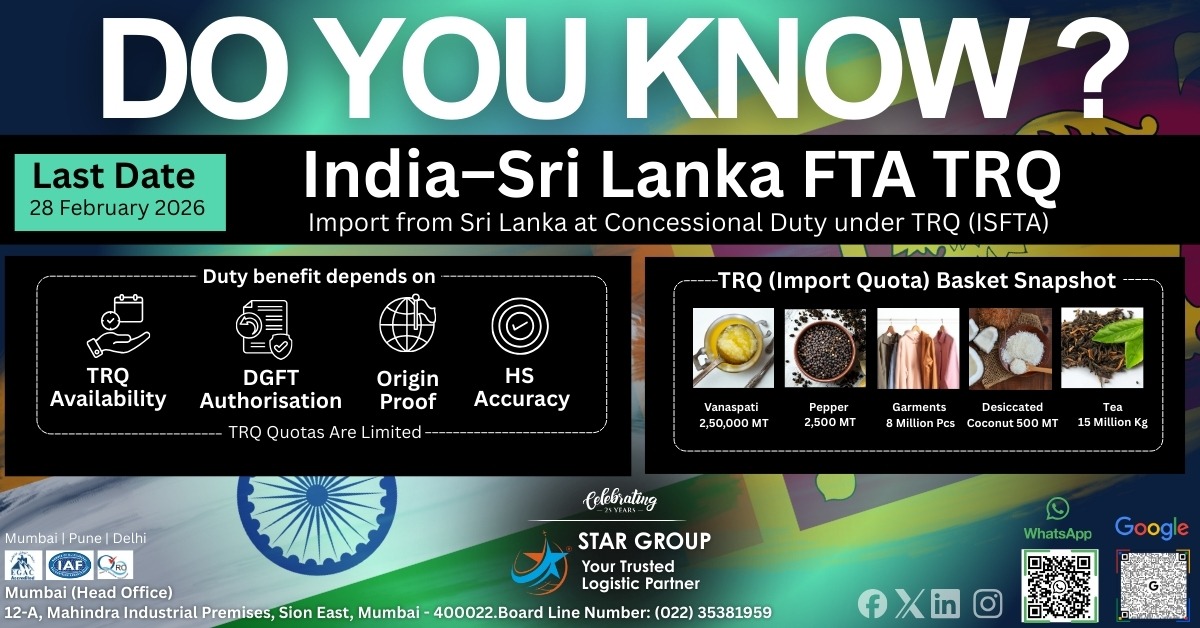
Under the India–Sri Lanka Free Trade Agreement (ISFTA), certain Sri Lanka–origin goods can be imported into India under a Tariff Rate Quota (TRQ) at concessional or Nil Customs duty. Once the notified annual quota is exhausted, imports attract normal tari...

India–Mauritius CECPA TRQ for Indian Importers: Products, Quota, HS Codes & DGFT Process

India–Mauritius CECPA TRQ for Indian Importers: Products, Quota, HS Codes & DGFT Process

February 19, 2026

Under the India–Mauritius CECPA, select products can be imported into India under a Tariff Rate Quota (TRQ). TRQ allows importers to claim a preferential in-quota duty rate for a notified quantity, subject to DGFT procedure and Customs compliance.  What i...

India–UAE CEPA TRQ: DGFT Process, Eligible Importers, Product List & Duty Concessions

India–UAE CEPA TRQ: DGFT Process, Eligible Importers, Product List & Duty Concessions

February 20, 2026

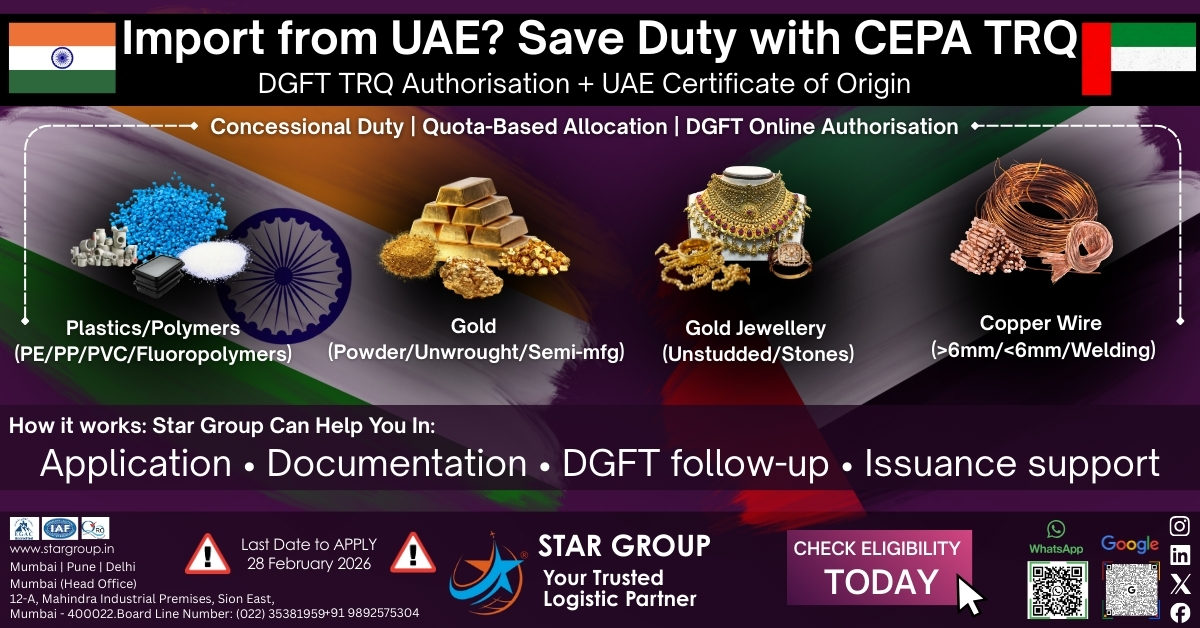
How to use DGFT TRQ authorisation to import select items from UAE at concessional customs duty (with official rules + product snapshot) What is TRQ under India–UAE CEPA?Under the India–UAE Comprehensive Economic Partnership Agreement (CEPA), certain produ...

DGFT Extends TRQ Application Last Date to 15 March 2026 for FY 2026-27

DGFT Extends TRQ Application Last Date to 15 March 2026 for FY 2026-27

February 25, 2026

Country-wise TRQ Items Covered Under Sri Lanka, Mauritius, Nepal, UAE & MercosurThe Directorate General of Foreign Trade (DGFT), Ministry of Commerce & Industry, has issued Public Notice No. 50/2025-26 dated 24 February 2026, extending the deadline for fi...

Interest Subvention for MSME Exporters (DGFT – EPM Niryat Prothsahan): What Small Exporters Need to Know (Trade Notice No. 20/2025-26, dated 02 Jan 2026)

Interest Subvention for MSME Exporters (DGFT – EPM Niryat Prothsahan): What Small Exporters Need to Know (Trade Notice No. 20/2025-26, dated 02 Jan 2026)

March 04, 2026

OverviewDGFT has launched “Interest Subvention for Pre- and Post-Shipment Export Credit” under the Export Promotion Mission (EPM) – Niryat Prothsahan through Trade Notice No. 20/2025-26 dated 02 January 2026, with immediate effect. The intervention is ope...

Import Duty Payment Just Got Easier: CBIC Extends Deferred Payment to 30 Days (Effective Feb 2026)

Import Duty Payment Just Got Easier: CBIC Extends Deferred Payment to 30 Days (Effective Feb 2026)

March 12, 2026

Do you know that the Government of India now allows eligible importers to pay customs duty after 30 days instead of paying it upfront?In a major relief for compliant importers and domestic manufacturers, the Central Board of Indirect Taxes and Customs (CB...

Eligible Manufacturer Importer (EMI) Scheme: Why This Customs Update Matters for Manufacturer-Importers

Eligible Manufacturer Importer (EMI) Scheme: Why This Customs Update Matters for Manufacturer-Importers

May 15, 2026

The Central Board of Indirect Taxes and Customs (CBIC) has introduced an important facilitation measure for eligible manufacturer-importers through the Eligible Manufacturer Importer (EMI) Scheme. Under this framework, approved EMI entities can clear impo...

Transition Facilitation (Quality Control) Order, 2026: What Businesses Should Know

Transition Facilitation (Quality Control) Order, 2026: What Businesses Should Know

June 30, 2026

The Ministry of Commerce and Industry, through the Department for Promotion of Industry and Internal Trade (DPIIT), has notified the Transition Facilitation (Quality Control) Order, 2026.This notification is important for businesses dealing with selected ...

EDPMS & IDPMS Reconciliation: How Exporters and Importers Can Clear Pending Entries

EDPMS & IDPMS Reconciliation: How Exporters and Importers Can Clear Pending Entries

August 05, 2026

An export payment may have been received—or an import payment completed—yet the related Shipping Bill or Bill of Entry may still appear as outstanding in the banking system.These pending records can arise from missing documents, incorrect references, diff...

Certificate of Origin (CoO): A Complete Guide Meaning, Types, Rules, Process and Documents

Certificate of Origin (CoO): A Complete Guide Meaning, Types, Rules, Process and Documents

August 05, 2026

In international trade, the country from which goods are shipped is not always their country of origin.A product may be exported from India, contain inputs sourced from several countries and still qualify—or fail to qualify—as Indian-origin, depending on ...

India–Oman CEPA TRQ 2026–27: Eligible Products, In-Quota Duty Rates and Application Guide

India–Oman CEPA TRQ 2026–27: Eligible Products, In-Quota Duty Rates and Application Guide

August 05, 2026

The Directorate General of Foreign Trade (DGFT) has invited applications for Tariff Rate Quota (TRQ) allocation under the India–Oman Comprehensive Economic Partnership Agreement (CEPA) for FY 2026–27.Applications can be submitted from 4 August 2026 to 19 ...

RoDTEP Scroll Suspension for 850 IECs: JNCH Public Notice 128/2026

RoDTEP Scroll Suspension for 850 IECs: JNCH Public Notice 128/2026

October 10, 2026

Jawaharlal Nehru Custom House (JNCH), Nhava Sheva, issued Public Notice No. 128/2026 on 8 October 2026 after receiving representations about RoDTEP scrolls not being generated for certain Shipping Bills. The issue related to alerts or suspension shown aga...

RoDTEP Annual Return Filing: What Exporters on JNCH’s 850-IEC List Should Do

RoDTEP Annual Return Filing: What Exporters on JNCH’s 850-IEC List Should Do

November 19, 2026

Exporters searching for RoDTEP ARF filing should know that DGFT’s official term is Annual RoDTEP Return (ARR). The return records information related to RoDTEP claims and supporting export, input and tax data.The issue became especially visible after Jawa...

Diamond Imprest Authorisation (DIA) Scheme: Eligibility, Benefits, Documents and Export Rules

Diamond Imprest Authorisation (DIA) Scheme: Eligibility, Benefits, Documents and Export Rules

November 27, 2026

India’s Diamond Imprest Authorisation (DIA) Scheme is a foreign-trade facility for eligible diamond exporters. It allows qualifying exporters to import specified natural cut and polished diamonds including semi-processed, half-cut and broken diamonds, pro...

Download Broucher

Get a Quick Quote
for Your Import-Export & Logistics Needs