
Eligible Manufacturer Importer (EMI) Scheme: Why This Customs Update Matters for Manufacturer-Importers

May 11, 2026
Eligible Manufacturer Importer (EMI) Scheme: Why This Customs Update Matters for Manufacturer-Importers

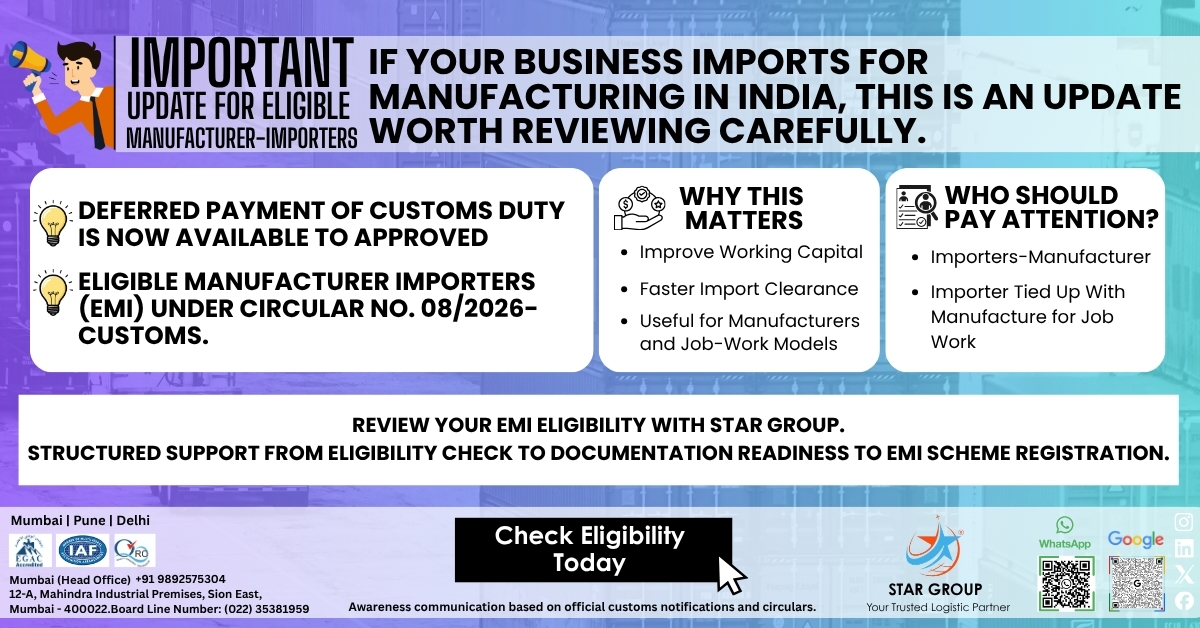
The Central Board of Indirect Taxes and Customs (CBIC) has introduced an important facilitation measure for eligible manufacturer-importers through the Eligible Manufacturer Importer (EMI) Scheme. Under this framework, approved EMI entities can clear imported goods without paying customs duty at the time of clearance and pay the applicable duty later as per the Deferred Payment of Import Duty Rules, 2016. The online application window opened from 1 March 2026, while the deferred payment facility is available from 1 April 2026 till 31 March 2028

For businesses that import inputs, capital goods, or manufacturing-linked consignments regularly, this is more than a procedural update. It directly affects working capital planning, customs clearance efficiency, compliance governance, and internal control readiness. CBIC has also positioned the EMI framework as a trust-based facilitation scheme, with an expectation that approved entities may progressively move toward AEO-T2/AEO-T3 accreditation over time. 

Important clarification

The EMI Scheme should not be presented as a blanket customs benefit for all importers. It is available only to those applicants that meet the prescribed manufacturer-importer / eligible job-work structure, customs footprint, GST compliance, turnover, financial solvency, and clean-track-record conditions set out in the circular. 

What is the EMI Scheme?

Under Notification No. 12/2026-Customs (N.T.) dated 1 February 2026, a new class called Eligible Manufacturer Importer was inserted for the purpose of deferred payment of import duty, with the benefit permitted up to 31 March 2028. The detailed eligibility conditions, operational guidelines, application process, nodal-person requirement, and customs system flow were then issued through Circular No. 08/2026-Customs dated 28 February 2026

In simple terms, EMI works on a clear first, pay later model for customs import duty, subject to the prescribed rules. That can be particularly relevant for businesses managing recurring imports and production-linked timelines. 

Why this update is important for businesses

For eligible manufacturer-importers, the EMI framework can be operationally significant for five reasons:

1. Better working-capital management

Customs duty need not be paid at the moment of each clearance; it can be paid later in the prescribed deferred cycle. This can help reduce immediate cash-flow pressure on import-linked manufacturing operations. 

2. Faster and smoother import clearances

CBIC has expressly stated that the facility is expected to expedite customs clearance of imported goods at ports, airports, and ICDs. 

3. Stronger compliance discipline

EMI is clearly built for businesses with documented customs and GST hygiene. Eligibility is linked to GST filing discipline, turnover threshold, financial solvency, and absence of adverse enforcement history. 

4. Governance value for large groups and MNCs

For larger organizations, especially those with multi-location operations and internal compliance frameworks, EMI readiness can support stronger coordination between tax, customs, finance, supply chain, and plant-level documentation functions. This is an operational inference from the scheme design, which relies on verified GST/manufacturing declarations, solvency support, nodal authentication, and system-based customs processing. 

5. Pathway toward higher facilitation status

The circular states that the scheme is expected to help approved EMI entities obtain AEO-T2 / AEO-T3 accreditations within the validity period, unlocking broader facilitation and priority-treatment benefits under the AEO framework. 

Who can apply under the EMI Scheme?

An applicant must be an importer under the Customs Act and must also satisfy one of these business conditions:

be a manufacturer as defined under the GST Act, 2017, or

if not a manufacturer, be an importer sending inputs/capital goods to a job worker under Section 143 of the CGST Act without payment of tax. 

The circular also clarifies that existing AEO-T1 entities, including MSMEs, may apply under the scheme if they meet the EMI eligibility conditions. 

EMI eligibility checklist

A business seeking EMI approval should broadly evaluate the following conditions before applying:

valid Importer Exporter Code (IEC) issued by DGFT

at least 25 EXIM documents in the previous financial year; 10 documents for MSME applicants

at least one active GST registration

manufacturing declaration in FORM REG-01 showing the relevant premises as factory/manufacturing, or in job-work cases, filing of the last two half-yearly GSTR ITC-04 along with the job worker’s qualifying GST/manufacturing declaration

annual aggregate turnover of all GSTINs under the same PAN exceeding ₹5 crore in the last financial year

minimum 2 financial years of business continuity

all pending GSTR-3B returns filed as on the application date

financial solvency supported by a Chartered Accountant certificate

no arrest, conviction, or pending prosecution under the relevant Customs, GST, Central Excise, Service Tax, or other applicable laws

no false-document / forged-document related past rejection or suspension under EMI. 

Key documents likely to be required

Based on the uploaded brief and the circular appendices, applicants should expect document-backed verification around the following:

IEC copy

PAN copy

GST registration certificates for all GSTINs under the PAN

UDYAM certificate, if applicable

GST ITC-04, where applicable

GSTR-9C, where applicable, evidencing turnover and GST paid for the last financial year

Chartered Accountant certificate with UDIN in the prescribed format

audited financial statements for the last two financial years

land / lease / rent / title documents supporting property-holding rights

authorization letter for authorized signatory

business and customs filing details relevant to the application. 

Application process under the EMI Scheme

The application is to be filed electronically on the AEO portal under the tab “Eligible Manufacturer Importer”. As per the circular, applications can be submitted from 1 March 2026 in the prescribed format under Appendix-I, along with documents under Appendix-II and the CA certificate under Appendix-III. The application is processed by the Directorate of International Customs (DIC), CBIC. Once approved, the relevant details are updated in the Customs Automated System. 

After approval, the EMI must appoint or authorize a nodal person who will obtain ICEGATE login and authenticate customs-related transactions on behalf of the EMI. To avail deferred duty payment in a Bill of Entry (BoE), the importer must indicate flag “D” in the payment method column, and the nodal person must authenticate the transaction through the prescribed ICEGATE mechanism. 

Deferred duty payment timeline

As reproduced in the circular from the amended rules:

for goods corresponding to Bills of Entry returned for payment from the 1st day to the last day of any month other than March, duty is payable by the 1st day of the following month

for goods corresponding to Bills of Entry returned for payment from 1st March to 31st March, duty is payable by 31st March

Why clients should assess this early

Even though EMI is a facilitation opportunity rather than a compulsory filing, the readiness required to access it is substantial. A business may need to review:

Whether Its GST Registration Data Properly Reflects Manufacturing Activity

Whether Its Customs Filing Footprint Is Sufficient

Whether Pending GST Compliance Items Are Fully Regularized

Whether Its Documentation Supports Financial Solvency And Operational Continuity

Whether Its Internal Customs, Finance, And Tax Teams Can Manage Nodal Authentication And Deferred-Payment Governance. 

For MNCs and professionally managed businesses, this matters not only from a cash-flow perspective but also from a reputation, governance, and compliance-readiness standpoint. Preventive compliance is almost always stronger than reactive correction after a delay, objection, or control failure.

How Star Group can support

At Star Group, the objective is not just application support, but structured readiness support. This may include:

preliminary eligibility review against EMI conditions

customs and GST documentation review

gap assessment for manufacturing declaration / job-work documentation

support in collating application documents and appendices

assistance in process readiness for nodal-person and ICEGATE workflow

practical advisory on aligning EMI readiness with broader compliance and facilitation goals.

Official documents and notification links

For authenticity and internal review, refer to these official documents:

Notification No. 12/2026-Customs (N.T.) dated 1 February 2026 – extension of deferred payment facility to Eligible Manufacturer Importers. 

Notification No. 13/2026-Customs (N.T.) dated 1 February 2026 – amendment to the Deferred Payment of Import Duty Rules, 2016, including revised due dates. 

Circular No. 08/2026-Customs dated 28 February 2026 – detailed EMI eligibility, process, documentation, and operations. 

AEO India EMI page – official EMI resource page hosted by Indian Customs. 

PIB press release dated 1 March 2026 – official explanatory announcement on the scheme. 

Disclaimer

Disclaimer: This article is intended solely for general awareness and educational purposes for our audience. It is based on the user brief shared with us and on official government sources available at the time of writing, including the relevant CBIC / AEO / PIB notifications and circulars. It should not be treated as legal opinion, tax opinion, or a substitute for transaction-specific professional advice. Readers should refer to the latest official notifications, circulars, portal instructions, and consult qualified professionals before taking any decision or filing any application.

Frequently Asked Questions

No. EMI is a deferred duty payment facility, not an exemption or waiver of customs duty. Duty payment is deferred and governed by the applicable rules. 

The circular states that the facility is available to eligible EMIs from 1 April 2026. Applications can be filed from 1 March 2026

Yes, MSMEs can apply if they meet the eligibility conditions. For MSME applicants, the minimum customs-document requirement is relaxed from 25 to 10 EXIM documents

Yes. Existing AEO-T1 entities, including MSMEs, are eligible to apply if they satisfy the EMI conditions. 

Yes, the circular specifically covers an importer that sends inputs/capital goods to a job worker under Section 143 of the CGST Act, subject to the prescribed GST and documentation conditions. 

The application is processed by the Directorate of International Customs (DIC), CBIC), and the approved details are updated in the Customs Automated System. 

The approved EMI must operate through an authorized nodal person, obtain the relevant ICEGATE access, and authenticate the use of deferred payment in the Bill of Entry workflow. 

Have any doubts? Please fill the form below to get in touch with us.

Related Blogs

What are the documents required for import & export

What are the documents required for import & export

April 04, 2022

In this article, we are going to have a look at all the necessary documents required for the import and export procedure to be completed successfully.These import and export documents are essential to be kept in mind while importing or exporting goods.Let...
What is the procedure of Custom Clearance for Export?

What is the procedure of Custom Clearance for Export?

April 04, 2022

The Export clearance procedure is an important step while exporting goods from India.Customs Clearance is the process of authorization of a person or goods by the Customs Department.The authorization takes place after providing the proper customs clearanc...

What is the procedure of import and export in India?

What is the procedure of import and export in India?

April 04, 2022

In this article, we are going to discuss in detail the procedure of Import and Export in India.The Foreign Trade (Development and Regulation) Act, 1992, of India regulates the import and export of goods. It also facilitates the government to make necessar...

Advance Ruling

Advance Ruling

September 18, 2024

Advance Ruling is Trade Facilitation as per WTO agreementImporters and Exporters who have ambiguity about their goods Classification, Duty structure and Valuation method can go for Advance Ruling. Advance Ruling will ensure tariff classification, exemptio...

Duty Free Import Authorization Scheme (DFIA)

Duty Free Import Authorization Scheme (DFIA)

October 02, 2024

Duty Free Import Authorization Scheme (DFIA) ObjectiveThis scheme providing duty free inputs on post exports basis as a  replenishment so that export product becomes competitive in the international market.DFIA is freely transferable. Eligibility Criteria...

Self-Sealing Permission ( SSP )

Self-Sealing Permission ( SSP )

October 03, 2024

Self-Sealing Permission Purpose Central Board of Indirect Taxes and Custom (CBIC ) has approved the program to promote exports Self Sealing Permission earlier was called as Factory Stuffing Permission; this permits containerize cargo to seal at their fact...

RESTRICTED LICENSE

RESTRICTED LICENSE

October 16, 2024

RESTRICTED LICENSEAs per the provisions of Exim Policies, The Central Government, in public interest, regulates the import or export of goods by means of a Negative List. This Negative Lists consist of goods for Export & import which are prohibited or res...

Brand Rate Fixation (Custom Act Section 75)

Brand Rate Fixation (Custom Act Section 75)

October 16, 2024

Brand Rate Fixation (Custom Act Section 75) When the manufacturer import the Raw material, Components & packing material after paying the Basic Custom Duty (BCD) & Social Welfare Surcharge (SWS) and utilizing the same for the manufacturing of export produ...

Preferential Trade Agreements

Preferential Trade Agreements

October 16, 2024

Preferential Trade Agreements A key benefit under PTA is preferential tariff, i.e. applicability of lower customs duty on import of goods from partner countries. India has notified separate rules for determining whether goods being imported from a country...

Status Holder Certificate

Status Holder Certificate

October 23, 2024

Status Holder Certificate All exporters of goods & services having an import-export code (IEC) number shall be eligible for recognition as a status holder on achieving specific turnover. Status recognition depends upon export performance An applicant shal...

Re- Import of Goods without payment of Duty

Re- Import of Goods without payment of Duty

October 23, 2024

 Re- Import of Goods without payment of Duty Re-importing goods without payment of duty is allowed under various Customs notifications. Goods that were earlier exported can be brought back into the country without payment of import duties and taxes.Common...

Import of Goods for display in Trade Fairs and events without payment of Customs Duty

Import of Goods for display in Trade Fairs and events without payment of Customs Duty

November 07, 2024

Import of Goods for display in Trade Fairs and events without payment of Customs Duty Conditions: The importer must submit a Specific declaration, Re- export bond with bank guarantee 10% of duty amount. Imports by government entities, diplomatic missions,...

Union Budget 2025: Boosting MSMEs with New Credit Schemes and Classification Changes

Union Budget 2025: Boosting MSMEs with New Credit Schemes and Classification Changes

February 21, 2025

The Union Budget 2025-26 has unveiled transformative measures to bolster India's Micro, Small, and Medium Enterprises (MSMEs), recognizing their pivotal role in economic growth and employment generation.Enhanced MSME Classification CriteriaTo facilitate s...

Understanding Bharat Trade Net (BTN): Simplifying India's International Trade

Understanding Bharat Trade Net (BTN): Simplifying India's International Trade

February 22, 2025

IntroductionTo make international trade easier and more efficient for Indian businesses, the government has introduced a new digital platform called Bharat Trade Net (BTN). Announced during the Union Budget 2025, BTN aims to streamline trade processes, ma...

India’s Budget 2025-26: Duty Exemptions to Boost the Leather Industry

India’s Budget 2025-26: Duty Exemptions to Boost the Leather Industry

February 22, 2025

The Union Budget 2025-26 has introduced significant changes in customs duties related to the leather industry, benefiting both importers and exporters. Import of Wet Blue leather is now fully exempt from Basic Customs Duty (BCD).Export of Crust leather is...

Fueling Self-Reliance: India’s Push for Lithium-Ion Battery Manufacturing

Fueling Self-Reliance: India’s Push for Lithium-Ion Battery Manufacturing

February 22, 2025

The Union Budget 2025 has introduced a significant push for domestic manufacturing and value addition, particularly in the lithium-ion battery sector. With a growing emphasis on electric mobility and self-reliance, Finance Minister Nirmala Sitharaman anno...

Budget 2025: Boost for Clean Energy – Duty Exemptions on Cobalt Powder &waste, Scrap of Lithium-Ion Battery & 12 Critical Minerals

Budget 2025: Boost for Clean Energy – Duty Exemptions on Cobalt Powder &waste, Scrap of Lithium-Ion Battery & 12 Critical Minerals

February 22, 2025

The Indian government has taken a significant step towards strengthening the clean energy and electric vehicle (EV) sectors. In Budget 2025, Finance Minister Nirmala Sitharaman announced the exemption of customs duty on cobalt powder & waste, scrap of lit...

Comprehensive Guide to BIS Scheme X Certification: Ensuring Safety and Compliance in Machinery and Electrical Equipment

Comprehensive Guide to BIS Scheme X Certification: Ensuring Safety and Compliance in Machinery and Electrical Equipment

September 04, 2025

IntroductionIn today's rapidly evolving industrial landscape, ensuring the safety and quality of machinery and electrical equipment is paramount. The Bureau of Indian Standards (BIS) introduced Scheme X under the Conformity Assessment Regulations to addre...

MoFPI Invites Proposals for Multi-Product Food Irradiation Units Under PMKSY: Eligibility, Grant Pattern & How to Apply

MoFPI Invites Proposals for Multi-Product Food Irradiation Units Under PMKSY: Eligibility, Grant Pattern & How to Apply

January 12, 2026

The Ministry of Food Processing Industries (MoFPI), Government of India has issued a Notice Inviting Proposals for financial assistance to set up multi-product food irradiation units under the component scheme “Integrated Cold Chain and Value Addition Inf...

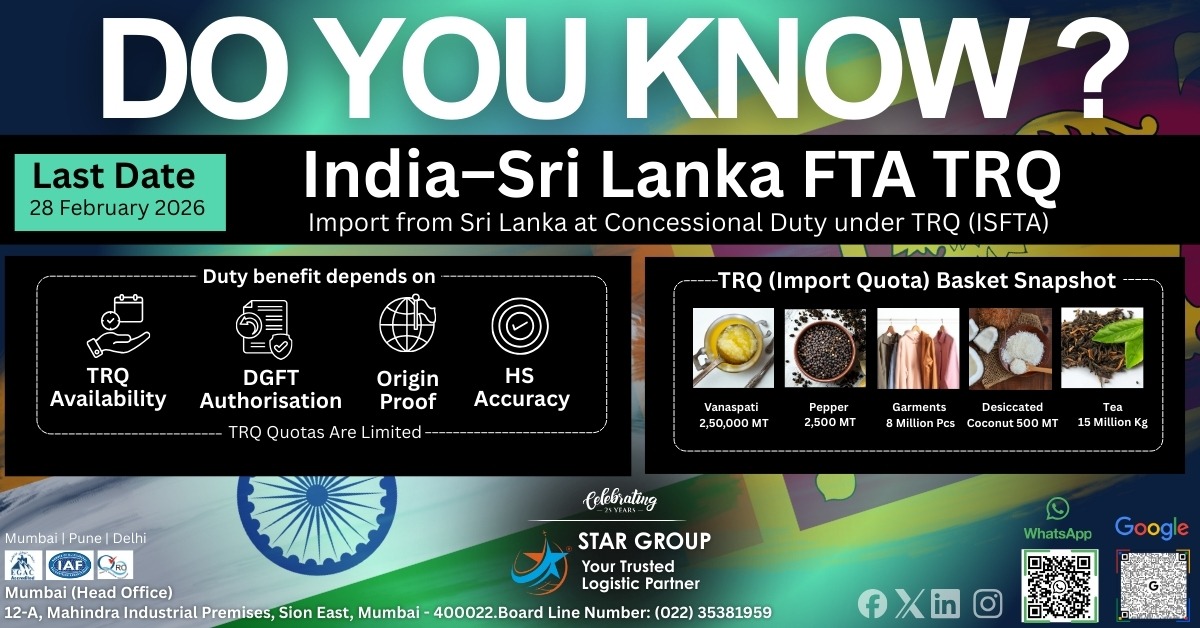
India–Sri Lanka FTA TRQ (Import Quota): Notifications, Quota Limits & How to Use the Benefit

India–Sri Lanka FTA TRQ (Import Quota): Notifications, Quota Limits & How to Use the Benefit

February 13, 2026

Under the India–Sri Lanka Free Trade Agreement (ISFTA), certain Sri Lanka–origin goods can be imported into India under a Tariff Rate Quota (TRQ) at concessional or Nil Customs duty. Once the notified annual quota is exhausted, imports attract normal tari...

India–Mauritius CECPA TRQ for Indian Importers: Products, Quota, HS Codes & DGFT Process

India–Mauritius CECPA TRQ for Indian Importers: Products, Quota, HS Codes & DGFT Process

February 19, 2026

Under the India–Mauritius CECPA, select products can be imported into India under a Tariff Rate Quota (TRQ). TRQ allows importers to claim a preferential in-quota duty rate for a notified quantity, subject to DGFT procedure and Customs compliance.  What i...

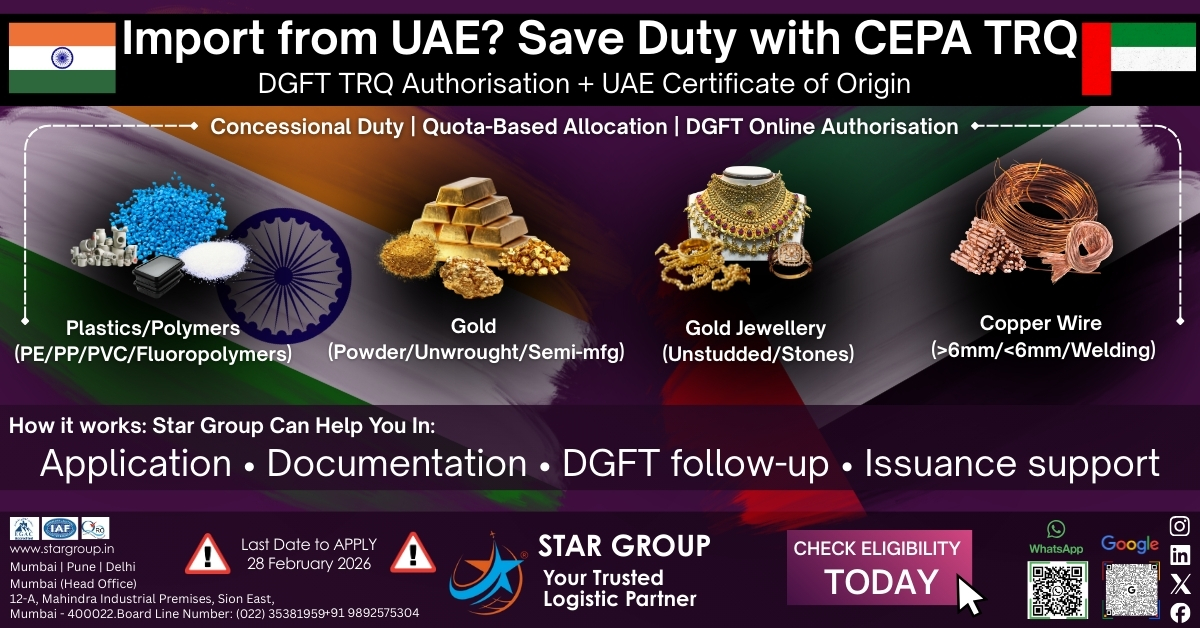
India–UAE CEPA TRQ: DGFT Process, Eligible Importers, Product List & Duty Concessions

India–UAE CEPA TRQ: DGFT Process, Eligible Importers, Product List & Duty Concessions

February 20, 2026

How to use DGFT TRQ authorisation to import select items from UAE at concessional customs duty (with official rules + product snapshot) What is TRQ under India–UAE CEPA?Under the India–UAE Comprehensive Economic Partnership Agreement (CEPA), certain produ...

DGFT Extends TRQ Application Last Date to 15 March 2026 for FY 2026-27

DGFT Extends TRQ Application Last Date to 15 March 2026 for FY 2026-27

February 25, 2026

Country-wise TRQ Items Covered Under Sri Lanka, Mauritius, Nepal, UAE & MercosurThe Directorate General of Foreign Trade (DGFT), Ministry of Commerce & Industry, has issued Public Notice No. 50/2025-26 dated 24 February 2026, extending the deadline for fi...

Interest Subvention for MSME Exporters (DGFT – EPM Niryat Prothsahan): What Small Exporters Need to Know (Trade Notice No. 20/2025-26, dated 02 Jan 2026)

Interest Subvention for MSME Exporters (DGFT – EPM Niryat Prothsahan): What Small Exporters Need to Know (Trade Notice No. 20/2025-26, dated 02 Jan 2026)

March 04, 2026

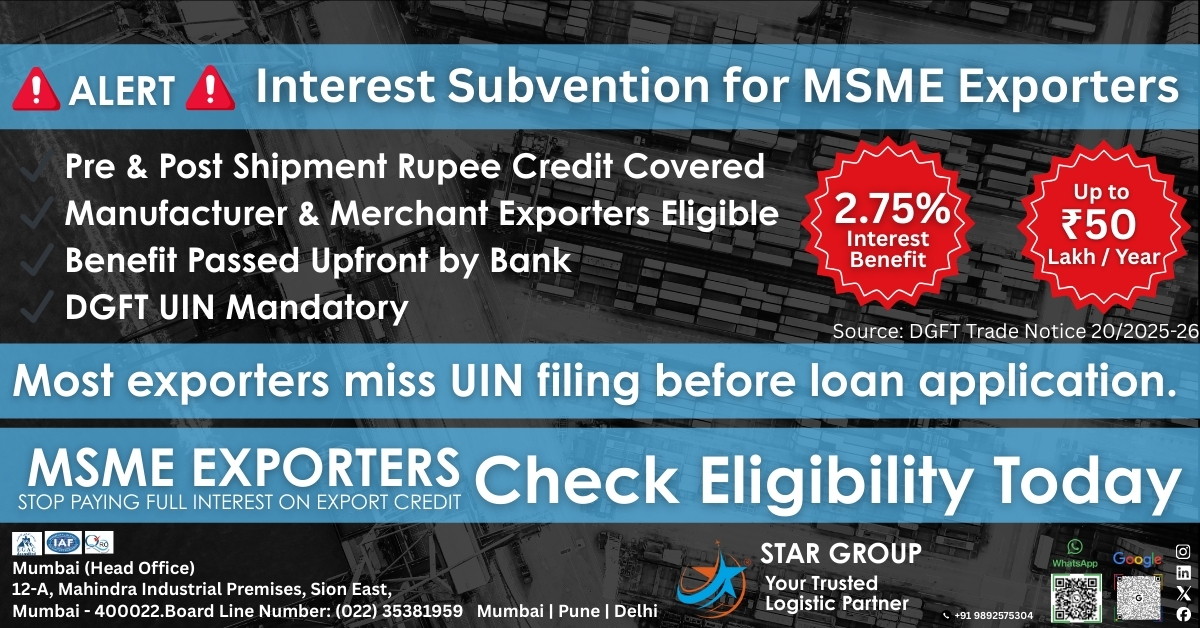
OverviewDGFT has launched “Interest Subvention for Pre- and Post-Shipment Export Credit” under the Export Promotion Mission (EPM) – Niryat Prothsahan through Trade Notice No. 20/2025-26 dated 02 January 2026, with immediate effect. The intervention is ope...

Import Duty Payment Just Got Easier: CBIC Extends Deferred Payment to 30 Days (Effective Feb 2026)

Import Duty Payment Just Got Easier: CBIC Extends Deferred Payment to 30 Days (Effective Feb 2026)

March 12, 2026

Do you know that the Government of India now allows eligible importers to pay customs duty after 30 days instead of paying it upfront?In a major relief for compliant importers and domestic manufacturers, the Central Board of Indirect Taxes and Customs (CB...

Eligible Manufacturer Importer (EMI) Scheme: Why This Customs Update Matters for Manufacturer-Importers

Eligible Manufacturer Importer (EMI) Scheme: Why This Customs Update Matters for Manufacturer-Importers

May 11, 2026

The Central Board of Indirect Taxes and Customs (CBIC) has introduced an important facilitation measure for eligible manufacturer-importers through the Eligible Manufacturer Importer (EMI) Scheme. Under this framework, approved EMI entities can clear impo...

Download Broucher

Get a Quick Quote
for Your Import-Export & Logistics Needs